

Software and Electronic Flags in Motorsport: Technology, Safety, and Performance
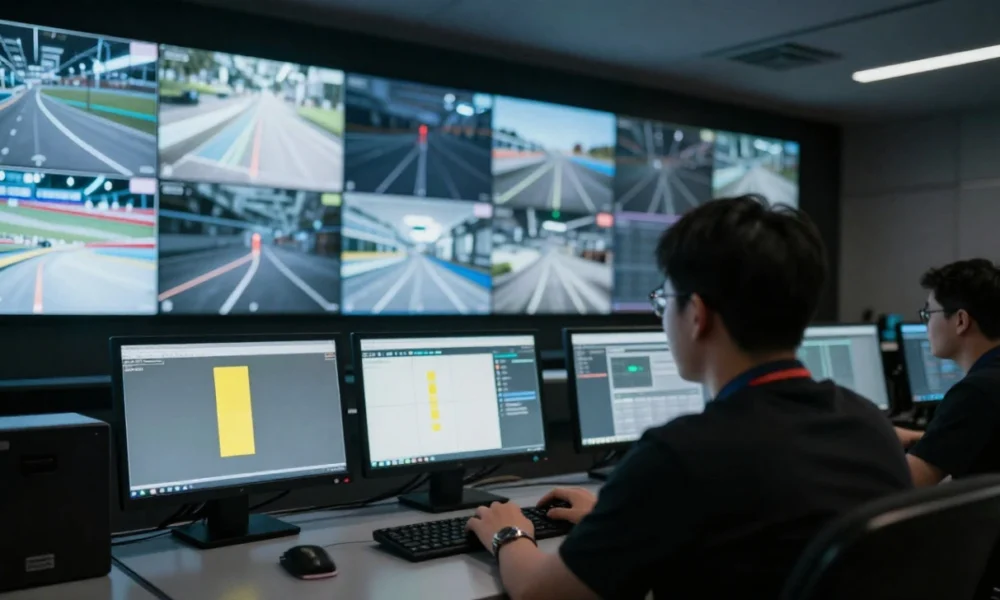
Modern motorsport runs on more than mechanical power. Software systems and electronic flag technology now shape how races are managed, how drivers receive critical track information, and how teams extract performance from their cars. From Formula 1 to club-level karting, these technologies have become central to both competition and safety.
Table Of Content
- How Software Became Central to Motorsport
- Engine Management Systems (EMS)
- Telemetry and Data Analysis
- Electronic Flag Systems: How They Work and Why They Matter
- Track-Side LED Panels
- In-Car Flag Notification Systems
- Integration with Race Control Software
- FIA Regulations and Homologation
- Software in Grassroots and Karting
- Autonomous Racing and Simulation
- 1. Autonomous racing
- 2. Racing simulation
- Conclusion
How Software Became Central to Motorsport
Racing has evolved steadily over the past century. Early improvements focused on engines, aerodynamics, and tires. From the 1980s onward, electronic systems began taking on a larger role — first in data logging, then in active engine management, and eventually in race control infrastructure.
Today, a competitive racing team relies on a layered architecture of hardware and software: engine control units, telemetry systems, simulation tools, and communication networks that tie the car, pit wall, and race control together in real time. These systems work alongside skilled engineers and drivers, not as replacements for human judgment, but as tools that provide faster, more accurate information.
Engine Management Systems (EMS)
The Engine Management System (EMS) — sometimes referred to as the Engine Control Unit (ECU) — sits at the center of race car electronics. It governs fuel injection mapping, ignition timing, boost pressure, throttle response, and real-time diagnostics.
In top-level championships, the ECU is often a standardized unit supplied by a designated manufacturer to ensure competitive balance. In Formula 1, for example, teams work within a regulated software environment while still customizing maps and parameters to suit their specific power unit architecture.
The practical benefit of a modern EMS is precision. Rather than relying on static calibration, the system continuously adjusts parameters based on live engine readings. This allows engineers to extract consistent performance across varying conditions — temperature, altitude, fuel load — without manually recalibrating between sessions. It also reduces mechanical failures caused by running the engine outside safe operating windows.
Telemetry and Data Analysis
Telemetry is the practice of transmitting live data from the race car to the engineering team, typically at the pit wall or in a remote operations center. Modern systems capture hundreds of channels simultaneously: engine temperatures, brake pressure, throttle position, steering angle, tire pressure and temperature, suspension travel, GPS position, and lap splits.
Engineers use this data in several ways. During a session, they monitor for signs of mechanical stress or driver behavior patterns. Between sessions, they compare data across laps and between teammates to identify where time is being gained or lost. Before races, strategists use historical data combined with predictive modeling to build pit stop and tire management plans.
| Data Channel | Primary Use |
|---|---|
| Engine parameters | Performance monitoring, fault detection |
| Tire pressure and temperature | Grip optimization, wear prediction |
| Driver inputs (throttle, brake, steering) | Technique analysis, coaching |
| GPS position and lap splits | Sector timing, strategy modeling |
| Suspension and brake data | Setup development |
The volume of data modern teams process is substantial. Some Formula 1 teams transmit hundreds of gigabytes of data over a race weekend. Purpose-built analysis platforms allow engineers to visualize and compare this information quickly, identifying patterns that would be invisible through observation alone.
Electronic Flag Systems: How They Work and Why They Matter
Traditional track marshaling relies on human flaggers positioned around the circuit, each displaying colored flags to communicate track conditions to passing drivers. While this system has functioned for decades, it has well-documented limitations: flags can be missed due to driver focus, obstructed sightlines, high speeds, or low visibility conditions such as rain and night racing.
Electronic flag systems address these limitations by replacing or supplementing physical flags with LED display panels positioned around the circuit and, in many implementations, in-car warning units that alert drivers directly.
Track-Side LED Panels
LED flag panels are installed at marshal posts around the circuit perimeter. Controlled centrally by race control software, these panels can display any required flag condition — yellow, double yellow, red, blue, safety car, virtual safety car, black, black and orange — across the full circuit or in specific sectors. The operator at race control changes conditions on a single screen, and the update propagates to every panel instantly.
Manufacturers such as EM Motorsport and Pixelcom supply panels that meet FIA and FIM homologation standards. Pixelcom’s panels comply with FIA Standard 3504-2019 and the FIM Racing Homologation Programme, with Grade 1 panels approved for use in Formula 1 and MotoGP, Grade 2 for series including the World Touring Car Cup and World Endurance Championship, and Grade 3 for Formula E and junior championships.
A practical benefit beyond driver communication is marshal safety. When flags can be controlled remotely from race control, the physical flagwaver no longer needs to stand at the trackside in proximity to passing cars. For categories like truck racing, where vehicle mass makes debris incidents particularly dangerous, this is a meaningful safety improvement.
In-Car Flag Notification Systems
A parallel development is the in-car electronic flag display. Systems such as Flagtronics deliver flag status directly to a display unit mounted in the cockpit. Using GPS coordinates, the system divides the circuit into zones corresponding to each corner station. When a flag condition is triggered at a specific station, any car within that zone receives an alert on its in-car display nearly instantaneously.
The SCCA introduced Flagtronics at the 2023 National Championship Runoffs at Virginia International Raceway, making it available to competitors in SCCA Pro Racing, SVRA, and Champ Car events. The FT200 unit includes a display, GPS antenna, and wiring harness, with an optional CAN Bus connection compatible with many dash systems. The system supplements rather than replaces traditional flagging rules — SCCA regulations still require drivers to observe the physical flag at the station — but it significantly reduces the likelihood of a flag being missed.
Integration with Race Control Software
Electronic flag systems are most effective when fully integrated with the broader race control infrastructure. Modern software platforms allow race directors to manage flag status, timing countdowns, session information, vehicle tracking, and safety car deployment from a single interface. Systems like the EM Motorsport EFS (Electronic Flag System) can manage multiple circuit configurations simultaneously, making them practical for facilities that run events on different track layouts.
This level of integration also creates a complete audit log. Every flag condition, the time it was activated, and the operator who triggered it is recorded. This has practical value for post-incident review and for demonstrating regulatory compliance.
FIA Regulations and Homologation
The FIA governs the technical standards for electronic flag systems used in licensed championships. FIA Standard 3504-2019 defines requirements for luminance, viewing angles, color accuracy, and response time for light panels used in official competition. Panels submitted for homologation must pass independent testing before being approved for use at a graded circuit.
For circuits seeking FIA Grade 1 status — required to host Formula 1 — fully operational electronic flag systems are part of the infrastructure requirements. Lower grades have corresponding requirements scaled to the level of competition the circuit intends to host.
The FIM operates a parallel homologation program for motorcycle racing venues, including MotoGP circuits, ensuring consistent safety standards across different motorsport disciplines.
Software in Grassroots and Karting
The same technology principles that apply at the highest level of the sport have reached club racing and karting, often at accessible price points.
- Lap timing and analysis software gives kart drivers access to sector splits, video overlay, and comparative analysis that was once available only to professional teams. Drivers can review where they are gaining or losing time against their own previous laps or against teammates.
- Setting up management tools allows teams to record kart configuration — gear ratios, tire pressures, chassis settings — alongside track conditions and lap time results. Over time, this builds a reference database that makes setup decisions faster and more informed.
- In-car flag systems such as the Pixelcom 4Flag and similar products are now available for karting facilities, including larger venues where physical flag visibility across distance can be a genuine problem.
For entry-level and club competitors, these tools compress the development timeline. A driver who would previously spend years building intuition through trial and error can now access structured data to guide improvement faster.
Autonomous Racing and Simulation
Two areas of technology are attracting increasing interest in motorsport circles: autonomous racing and high-fidelity simulation.
1. Autonomous racing
Autonomous racing competitions such as the Roborace concept and academic programs like the Indy Autonomous Challenge have demonstrated that self-driving cars can compete at speed. These competitions serve primarily as technology development platforms, testing perception systems, decision-making algorithms, and vehicle dynamics control under real competitive conditions rather than as entertainment products.
2. Racing simulation
Racing simulation has become a serious engineering tool. Teams use detailed circuit and vehicle models to test aerodynamic configurations, suspension setups, and race strategies before committing to physical testing. Simulator sessions also allow drivers to learn new circuits or re-familiarize themselves with tracks they haven’t visited recently. At the highest level, these simulators replicate tire behavior, fuel load changes, and surface degradation with a level of fidelity that makes the data genuinely useful for race preparation.
Artificial intelligence is beginning to appear in data analysis workflows, particularly for identifying patterns in large telemetry datasets and for building predictive models around tire degradation and fuel consumption. The primary application at this stage is decision support rather than autonomous race strategy, with engineers remaining responsible for final calls.
Conclusion
Software and electronic systems now touch every part of motorsport, from the ECU managing combustion events to the LED panel at a marshal post communicating a yellow flag condition in a specific circuit sector. The core benefits are consistent: faster communication, more accurate data, and reduced reliance on conditions that can fail — visibility, human reaction time, and physical positioning.
Electronic flag systems in particular represent a direct response to a long-standing safety limitation. By delivering flag conditions to drivers through in-car displays and high-visibility LED panels, and by recording every action at race control, these systems improve both the speed and the reliability of safety communication on track.
As these technologies become more affordable, their reach continues to extend from Formula 1 down to club racing and karting, raising baseline safety standards across the sport.