

EV Charging Solutions for Commercial Businesses: Benefits, Types, and What to Consider
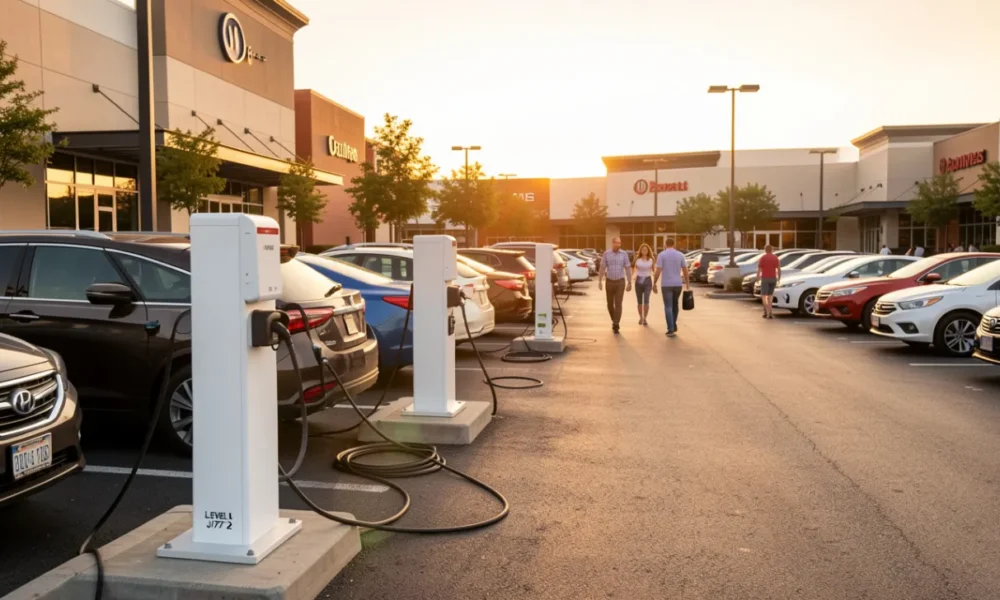
Electric vehicle adoption has accelerated steadily across both consumer and commercial markets, driven by tighter emissions regulations, falling battery costs, and growing corporate sustainability commitments. For businesses, this shift creates both an obligation and an opportunity: companies that install EV charging infrastructure now are better positioned to serve EV-driving customers, support employee needs, and meet future regulatory requirements.
Table Of Content
- Types of Commercial EV Chargers
- Level 2 Charging
- DC Fast Charging (DCFC)
- Networked vs. Non-Networked Stations
- Business Case: Why Commercial EV Charging Makes Financial Sense
- Reducing Fleet Operating Costs
- Revenue Generation
- Federal and State Financial Incentives
- Demand Charge Management
- Customer Experience and Competitive Positioning
- Regulatory Compliance and Future-Proofing
- Smart Charging and Technology Integration
- Key Factors to Evaluate Before Installation
- Conclusion
This guide covers what commercial EV charging solutions actually involve, the charger types available, the financial case for investment, and the factors that determine which setup makes sense for a given business.
Types of Commercial EV Chargers
Understanding the differences between charger levels is the starting point for any commercial EV charging deployment.
Level 2 Charging
Level 2 chargers operate on 208–240V AC power and typically deliver between 7 kW and 19.2 kW of output. They are the standard choice for commercial properties such as office buildings, retail centers, hotels, and parking garages, where vehicles remain parked for one to several hours. A Level 2 station can replenish 20–30 miles of range per hour, making them well-suited for employee workplace charging programs and customer-facing amenities. Most use the J1772 or combined CCS connector, and many modern units are NACS-compatible as well.
DC Fast Charging (DCFC)
DC fast chargers convert grid power directly to direct current and can deliver 50 kW to 350 kW, depending on the unit and the vehicle’s onboard charging limits. At higher power levels, a vehicle can reach 80% charge in under 30 minutes. DCFC stations are most appropriate for high-traffic locations — convenience stores, highway corridors, fleet depots, transit hubs, and public parking facilities — where short dwell times are the norm. The hardware and electrical infrastructure costs are significantly higher than Level 2, but so is the revenue potential and the competitive differentiation.
Networked vs. Non-Networked Stations
Commercial deployments almost always use networked charging stations, meaning each unit connects to a cloud-based charging station management system (CSMS). Networked stations allow operators to set pricing, monitor usage in real time, manage access permissions, and generate reports on energy consumption. Most commercial-grade hardware is OCPP (Open Charge Point Protocol) compatible, which prevents vendor lock-in by allowing the hardware to work with multiple software platforms.
Business Case: Why Commercial EV Charging Makes Financial Sense
Reducing Fleet Operating Costs
Companies running delivery vehicles, service fleets, or employee shuttle programs face ongoing fuel and maintenance costs. Electric vehicles have lower per-mile energy costs than gasoline or diesel equivalents and require less routine maintenance — no oil changes, fewer brake replacements due to regenerative braking, and fewer drivetrain components overall. Businesses that electrify their fleets and install on-site charging can reduce total cost of ownership (TCO) across the vehicle lifecycle, particularly as fleet size grows.
Revenue Generation
For businesses hosting public-facing charging stations, each charging port represents a direct revenue stream through per-kWh or per-session pricing. High-traffic locations — grocery stores, malls, restaurants — benefit from the additional dwell time that EV charging creates. EV drivers who stop to charge tend to spend time and money at nearby businesses while they wait.
Federal and State Financial Incentives
The 30C Alternative Fuel Vehicle Refueling Property Credit (IRS Form 8911) currently offers businesses a tax credit of up to 6% of installation costs per charging port, with a maximum of $100,000 per item. Businesses that meet IRS prevailing wage and apprenticeship requirements can qualify for a 30% credit on the same $100,000 per-port cap. As of the most recent verified information, the credit applies to qualified property placed in service through June 30, 2026, following changes introduced by the One Big Beautiful Bill Act signed in July 2025. Location eligibility is also a factor — the property must be situated in a qualifying low-income or non-urban census tract. Separate state-level rebates and utility incentive programs may further reduce upfront installation costs.
Demand Charge Management
One underappreciated financial consideration for commercial EV charging is demand charge management. Utilities bill commercial customers partly based on peak power draw within a billing period. Without load management controls, multiple vehicles charging simultaneously can spike peak demand and significantly increase utility bills. Smart charging systems distribute power across charging sessions to flatten demand peaks, reducing peak load charges and lowering ongoing operating costs.
Customer Experience and Competitive Positioning
Businesses in the retail, hospitality, and property sectors increasingly treat EV charging as a standard amenity rather than a niche offering. As EV penetration grows, drivers factor charging availability into decisions about where they shop, stay, work, and dine. Installing EV charging stations gives these businesses a measurable point of differentiation and supports customer retention.
Workplace charging is emerging as a notable employee benefit. Research consistently shows that a large share of EV charging happens at home and at work. Employers who offer Level 2 workplace charging make EV ownership more practical for staff, which can support hiring and retention efforts, particularly in competitive markets.
For property owners and managers, the presence of EV charging infrastructure can increase property appeal and long-term asset value as tenant expectations shift.
Regulatory Compliance and Future-Proofing
Emissions regulations are tightening across multiple jurisdictions. In the United States, California’s Advanced Clean Cars II rule phases out the sale of new gasoline-powered passenger vehicles by 2035, and similar policies are advancing in other states and internationally. The European Union has set a comparable 2035 deadline. For businesses operating fleets — particularly medium- and heavy-duty vehicles — compliance timelines are becoming a direct operational concern.
Installing EV charging infrastructure now aligns a business with the direction of regulatory travel. Companies that establish this capacity early avoid the higher costs and disruption of rushed compliance closer to regulatory deadlines, and they position themselves to meet any site-specific EV infrastructure mandates that may apply to parking facilities or commercial properties in their jurisdiction.
Sustainability commitments and ESG (Environmental, Social, and Governance) reporting are also relevant factors for larger commercial organizations. Supporting EV charging directly reduces Scope 1 and Scope 2 emissions reporting figures and demonstrates measurable progress toward corporate carbon reduction targets.
Smart Charging and Technology Integration
Modern commercial EV charging systems go well beyond simply delivering electricity to a vehicle. Smart charging platforms allow businesses to schedule charging sessions during off-peak utility hours, reducing energy costs. Integration with renewable energy sources — particularly on-site solar — allows businesses to charge vehicles using generated power rather than drawing entirely from the grid.
IoT-connected charging stations provide real-time monitoring, automated fault detection, and usage analytics. Some platforms integrate with energy storage systems (batteries), enabling businesses to store energy during low-rate periods and deploy it during high-demand charging windows, further managing electricity costs. Charging station management software can also connect with fleet management systems to automate charging assignments based on vehicle schedule and state of charge.
Key Factors to Evaluate Before Installation
Not every site is immediately ready for commercial EV charging, and the right approach depends on a number of site-specific variables.
- Electrical capacity: Level 2 installations may require panel upgrades or load assessment. DCFC installations are more demanding and often require coordination with the utility for service upgrades. A professional site assessment should precede any procurement decision.
- Number and placement of charging ports: Parking lot size, expected vehicle mix, and usage patterns all influence how many ports are needed and where they should be located. Over-building creates unnecessary upfront expense; under-building creates poor user experience and limits revenue.
- Connector standards: As NACS (North American Charging Standard) gains adoption alongside established CCS and J1772 connectors, businesses should consider deploying stations that support multiple connector types or are adapter-ready to serve the widest range of EV drivers.
- Network and software requirements: For businesses planning to charge a fee, network connectivity and payment processing capability are essential. For private employee-only deployments, simpler access-controlled or non-networked options may be sufficient.
- Maintenance and support: Commercial charging equipment requires periodic maintenance to maintain uptime. Businesses should evaluate warranty coverage, remote monitoring capabilities, and service response times when selecting hardware and platform providers.
Conclusion
Commercial EV charging solutions address a converging set of business priorities: reducing fleet operating costs, attracting and retaining customers and employees, meeting regulatory requirements, and demonstrating measurable sustainability progress. The range of available charger types, ownership models, and financial incentives means that viable options exist for businesses of nearly any size or type — from a single Level 2 station at a retail storefront to a multi-port DCFC network at a logistics depot.
Given the June 2026 deadline for the current federal 30C tax credit and the pace of regulatory change across major markets, the window for acting under the most favorable financial conditions is limited. Businesses that conduct a site assessment and begin planning now are best placed to manage costs and meet both current and future expectations.