

10 Easy DIY Home Improvement Projects to Upgrade Your Space This Weekend
Home improvement doesn’t require a full renovation budget or weeks of construction. Many of the most satisfying upgrades take nothing more than a free weekend, a handful of basic tools, and a willingness to get your hands a little dirty. Whether you want to boost your home’s resale value, improve daily functionality, or simply make a space feel more like yours, these ten projects are well within reach for most homeowners—including beginners.
Table Of Content
- Why Weekend DIY Projects Are Worth Your Time
- 10 Easy DIY Home Improvement Projects
- 1. Paint Walls, Cabinets, or Your Front Door
- 2. Install a Kitchen or Bathroom Backsplash
- 3. Swap Out Cabinet Hardware
- 4. Add or Replace Lighting Fixtures
- 5. Install Under-Cabinet Lighting
- 6. Hang Floating Shelves
- 7. Apply Peel-and-Stick Wallpaper
- 8. Create a Gallery Wall
- 9. Organize Closets with a Modular System
- 10. Refurbish Existing Furniture
- A Few Practical Notes
- Conclusion
Why Weekend DIY Projects Are Worth Your Time
Hiring contractors for small cosmetic upgrades rarely makes financial sense. Simple changes like new hardware or updated lighting can cost a fraction of professional rates when done yourself, and the results are often indistinguishable. Beyond the savings, there’s a practical benefit to tackling these projects room by room: you build familiarity with your home, develop useful skills, and avoid the overwhelm that comes with planning a large-scale remodel.
These projects are organized to help you pick one area, focus your weekend, and walk away with a noticeably better space.
10 Easy DIY Home Improvement Projects
1. Paint Walls, Cabinets, or Your Front Door
A fresh coat of paint remains one of the most affordable ways to transform a space. A single accent wall behind a bed or sofa can shift the entire mood of a room without requiring you to paint every surface. For kitchens and bathrooms, painting existing cabinets rather than replacing them can save thousands of dollars while delivering a comparable visual result.
Don’t overlook the front door. Repainting it in a bold, complementary color is one of the highest-return curb appeal projects available—it costs under $50 in most cases and takes a single afternoon. Satin or semi-gloss exterior paint holds up best against weather and door friction.
- Estimated time: 4–8 hours, depending on the scope
- Tools needed: Roller, angled brush, painter’s tape, sandpaper, primer
2. Install a Kitchen or Bathroom Backsplash
A backsplash protects walls from moisture and grease while acting as a strong visual focal point. For beginners, peel-and-stick tiles are the most accessible option—they require no grout, no adhesive mixing, and can be cut with a utility knife. Subway tile patterns and mosaic designs are widely available at home improvement stores like Home Depot and Lowe’s, and they come in ceramic, glass, and vinyl-composite finishes.
If you prefer traditional tile for a more permanent, polished result, the process involves applying mastic adhesive, pressing tiles into a grid pattern, and finishing with grout. Either approach can realistically be completed in a single weekend.
- Estimated time: 3–6 hours
- Tools needed: Utility knife or tile cutter, level, grout (for traditional tile), sponge
3. Swap Out Cabinet Hardware
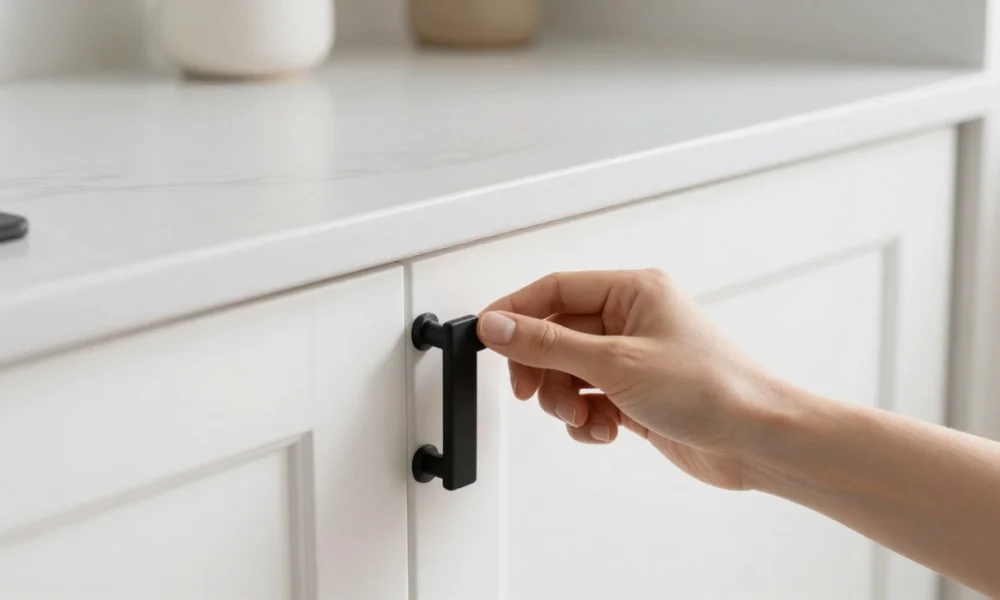
This is one of the fastest upgrades on this list and one of the most consistently underrated. Replacing knobs and pulls on kitchen or bathroom cabinets takes nothing more than a screwdriver and an hour of your time. The visual difference, however, is immediate—new hardware can make dated cabinetry look intentional and current.
Popular finish choices in 2025 and 2026 include matte black for modern or industrial spaces, brushed nickel for clean transitional interiors, and unlacquered brass for warmer, more traditional rooms. Before purchasing, measure the center-to-center distance on existing pulls to confirm new hardware will fit the same screw holes.
- Estimated time: 1–2 hours
- Tools needed: Screwdriver, measuring tape
4. Add or Replace Lighting Fixtures
Outdated light fixtures age a room quickly. Replacing a ceiling fixture, adding a pendant light over a kitchen island, or installing a statement chandelier in a dining room can shift the entire character of a space. Most fixtures come with clear installation instructions, and the work is manageable as long as you shut off the circuit at the breaker box before touching any wiring. If you’re not comfortable working with electrical connections, this is one project where hiring a licensed electrician for the installation portion is a reasonable call.
Also worth considering: switching to energy-efficient LED bulbs throughout the home. LED bulbs use significantly less electricity than incandescent alternatives and last far longer, reducing both energy bills and replacement frequency.
- Estimated time: 1–3 hours per fixture
- Tools needed: Voltage tester, wire connectors, screwdriver, ladder
5. Install Under-Cabinet Lighting
Under-cabinet lighting in the kitchen improves task lighting for cooking and prep work while giving the space a polished, high-end look. LED strip lights and puck lights are the most popular options. Battery-powered and plug-in versions are available if you want to avoid hardwiring entirely, making this a realistic one-hour project. The warm glow also highlights countertops and backsplash details that might otherwise go unnoticed.
- Estimated time: 1–3 hours
- Tools needed: Drill, screws or adhesive strips, depending on kit
6. Hang Floating Shelves
Floating shelves serve two purposes simultaneously: they add display space for books, plants, or decorative objects, and they break up large blank walls that might otherwise feel empty. They work particularly well in living rooms, home offices, entryways, and kitchens with open storage potential.
Installation requires locating wall studs for proper weight support—a stud finder makes this straightforward. Most floating shelf kits from retailers like IKEA, Wayfair, or Home Depot include all necessary mounting hardware and clear step-by-step instructions. This is a beginner-friendly project that can be completed in an afternoon.
- Estimated time: 2–4 hours
- Tools needed: Stud finder, drill, level, pencil
7. Apply Peel-and-Stick Wallpaper
Peel-and-stick wallpaper is a practical solution for renters and homeowners who want pattern or texture without the permanence of traditional wallpaper. A single accent wall in a bedroom or living room can create a focal point that makes the entire room feel more considered. It removes cleanly from most painted surfaces, making it easy to change when tastes shift.
For best results, apply to a low-humidity room like a bedroom or powder room rather than a kitchen or full bathroom, where moisture can affect adhesion over time. Bold geometric prints, subtle linen textures, and classic botanical patterns are all widely available.
- Estimated time: 2–4 hours
- Tools needed: Utility knife, smoothing tool, measuring tape, level
8. Create a Gallery Wall
A gallery wall turns an otherwise bare stretch of wall into a curated display of framed photographs, artwork, or prints. The key is planning the arrangement before putting any holes in the wall—lay the frames out on the floor first, adjust the composition until it feels balanced, then transfer the layout using paper templates taped to the wall.
Mixing frame sizes and finishes adds visual variety, while keeping frames within a consistent color family prevents the arrangement from feeling cluttered. This project costs very little if you already own art or photographs and simply need frames, which are widely available at affordable price points.
- Estimated time: 2–4 hours
- Tools needed: Level, hammer, picture hooks or adhesive strips, measuring tape
9. Organize Closets with a Modular System
A disorganized closet creates low-grade daily friction that adds up over time. Installing a modular closet system—with adjustable shelves, hanging rods, and drawer units—can convert a chaotic space into a functional one in a single weekend. Many home improvement stores carry complete kits that are designed for self-assembly without professional help.
If a full kit is outside the budget, targeted additions like a double hanging rod to stack shorter garments, a shoe rack, or labeled bins can make a meaningful difference at a lower cost. The goal is to create a system where everything has an assigned place.
- Estimated time: 4–8 hours
- Tools needed: Drill, level, measuring tape, screwdriver
10. Refurbish Existing Furniture
Before replacing a worn dresser, side table, or armchair, consider what it would take to restore it instead. Sanding and repainting or restaining wood furniture is straightforward and produces results that often look better than budget-priced new alternatives. Reupholstering a chair seat or bench cushion is similarly approachable—basic upholstery requires only a staple gun, replacement fabric, and foam padding.
This approach is both cost-effective and environmentally responsible, keeping functional items out of landfills while giving a room something distinctive that mass-produced furniture rarely offers.
- Estimated time: 4–8 hours, depending on the scope
- Tools needed: Sandpaper, paint or stain, brush, staple gun (for reupholstery)
A Few Practical Notes
- Match the project to your skill level. Start with hardware swaps or floating shelves before attempting electrical work or tile installation.
- Gather all materials before beginning. Mid-project hardware store runs waste time and momentum.
- Safety first with electrical work. Always confirm the circuit is off with a voltage tester before touching wiring.
- Measure twice. Whether it’s shelf placement, tile layout, or curtain rod height, taking an extra minute to verify measurements prevents costly mistakes.
Conclusion
The most effective home upgrades aren’t always the most expensive ones. A fresh coat of paint, new cabinet hardware, well-placed lighting, or a properly organized closet can change how a space feels to live in far more than their cost would suggest. Picking one project, completing it well, and building from there is a more reliable path to a home that works for you than waiting for the budget and bandwidth for a full remodel.