

Backup Power Solutions for Homes and Businesses | Complete Guide
Backup Power Solutions for Homes and Businesses to Maintaining continuous electricity during outages has become increasingly important as power disruptions affect more than 70 million Americans annually. Whether caused by severe weather, aging infrastructure, or grid instability, these interruptions can lead to significant financial losses, spoiled food, and disrupted operations. This guide examines the primary backup power options available in 2026, helping you select the right solution for your specific needs.
Table Of Content
- Understanding Your Backup Power Options
- Portable Generators
- Standby Generators
- Transfer Switches Explained
- Battery Backup Systems
- Leading Battery Systems
- Federal Tax Incentives
- Solar Power Systems with Battery Storage
- Uninterruptible Power Supplies (UPS)
- Cost Analysis and Return on Investment
- Selecting the Right System Size
- Installation Considerations
- Maintenance Requirements
- Making Your Decision
- Conclusion
Understanding Your Backup Power Options
Multiple solutions exist for maintaining electricity during outages, each serving different requirements and budgets. The main categories include portable generators, standby generators, battery backup systems, solar power with storage, and uninterruptible power supplies (UPS). Understanding the capabilities and limitations of each option forms the foundation for making an informed decision.
Power requirements vary significantly between residential and commercial applications. A typical home might need 7,000 to 24,000 watts of backup capacity, while businesses may require substantially more. Calculating your total wattage needs—including heating systems, refrigeration, essential electronics, and other equipment—helps determine which solution can realistically support your operations.
Portable Generators
Portable generators offer an entry-level solution for temporary power needs. These units typically run on gasoline, propane, or diesel fuel and can supply electricity to essential appliances during short outages. Most models range from 3,000 to 12,000 watts, with prices between $500 and $2,500.
The primary advantage of portable generators is affordability and flexibility. You can move them to different locations and store them when not needed. However, they require manual setup during outages, which can be inconvenient during emergencies. Their power output is limited compared to permanent installations, making them unsuitable for whole-home backup.
Regular maintenance is essential for reliable operation. Users must monitor fuel levels, perform oil changes, and run the unit periodically to prevent mechanical issues. Portable generators also produce carbon monoxide, requiring outdoor operation in well-ventilated areas at least 20 feet from any structure.
Standby Generators
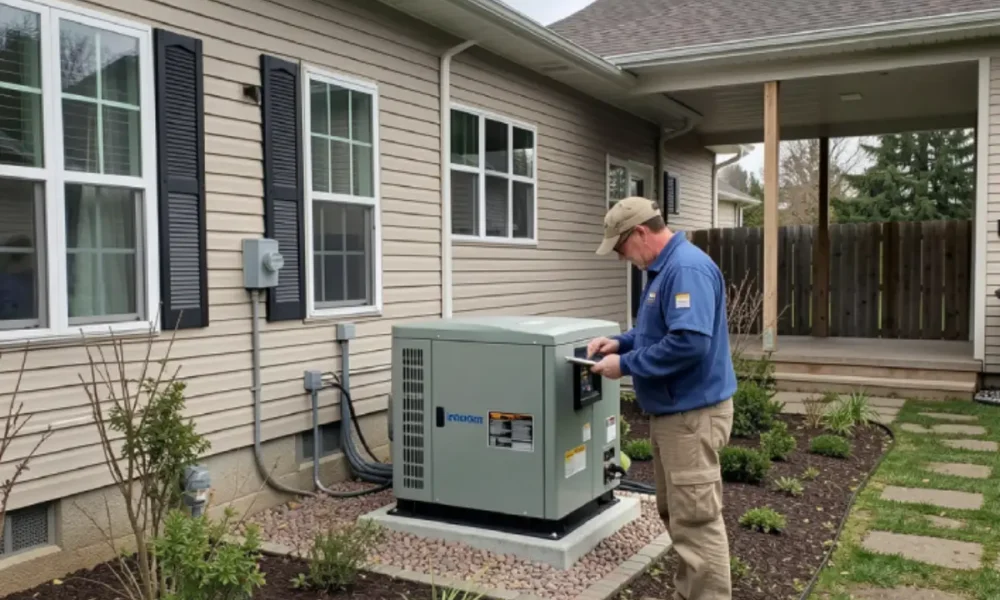
Standby generators provide permanent, automated backup power for homes and businesses. Installed outdoors and connected directly to your electrical system, these units detect power loss and activate automatically within 10-20 seconds. This automatic operation eliminates manual intervention, ensuring continuous power without disruption.
As of 2026, installed costs for standby generators range from $8,000 to $16,000 for residential systems, depending on capacity and installation complexity. Leading brands include Generac, Kohler, Cummins, and Briggs & Stratton, with models ranging from 7kW to 48kW for residential applications.
Standby generators typically run on natural gas or liquid propane. Natural gas provides virtually unlimited fuel through utility connections, while propane systems require periodic tank refills but offer independence from utility infrastructure. A 20kW generator running continuously consumes approximately 200-330 cubic feet of natural gas per hour, or 3-4 gallons of propane hourly.
Transfer Switches Explained
Every standby generator requires a transfer switch to function safely. This device disconnects your home from the utility grid during outages, preventing dangerous backfeeding that could injure utility workers. Two types exist:
Manual Transfer Switches ($500-$1,200 installed) require you to physically switch between grid and generator power. These work with portable generators and reduce installation costs.
Automatic Transfer Switches ($1,500-$2,500 installed) detect outages instantly and switch power sources without intervention. They’re standard with standby generators and essential for true backup automation.
Modern automatic transfer switches from manufacturers like Generac include load management features, allowing smaller generators to power entire homes by prioritizing essential circuits and cycling high-demand appliances.
Battery Backup Systems
Battery storage systems have gained significant traction in 2026, offering quiet, emissions-free backup power. These systems store grid or solar electricity for use during outages, with capacities typically ranging from 10kWh to 26kWh per unit.
Leading Battery Systems
Tesla Powerwall 3 remains the market leader with 13.5kWh capacity and 11.5kW continuous output. The installed cost ranges from $15,400 to $16,779 before incentives. Its integrated solar inverter simplifies installation and reduces equipment costs. The system supports up to 7 units for expanded capacity.
Enphase IQ Battery 10C offers 10kWh capacity with 7.08kW continuous output. The modular design allows up to 8 units for 80kWh total capacity. Installation costs range from $12,000 to $15,000 per unit. The 15-year battery warranty and 25-year microinverter coverage provide long-term protection.
LG Home 8 delivers 14.4kWh usable capacity with stackable configuration supporting up to 4 units. The system uses lithium iron phosphate (LiFePO4) technology for improved safety and longevity, with 6,000+ charge cycles expected.
Federal Tax Incentives
Battery storage systems qualify for the 30% federal solar tax credit (Investment Tax Credit) through 2032 under the Residential Clean Energy Credit program. This applies whether batteries are installed with solar panels or as grid-charged standalone systems. A $15,400 Powerwall installation reduces to $10,780 after the credit.
Some states offer additional incentives. California, Connecticut, Vermont, and other locations provide upfront rebates or ongoing bill credits through Virtual Power Plant (VPP) programs, where utilities compensate homeowners for allowing batteries to support grid stability during peak demand.
Solar Power Systems with Battery Storage
Combining solar panels with battery storage creates a self-sufficient backup system that recharges using sunlight. This approach reduces dependence on fossil fuels while providing long-term cost savings. During grid outages, stored solar energy keeps essential systems running without requiring fuel deliveries.
The initial investment for solar-plus-storage systems is substantial, typically $25,000 to $45,000 for residential installations depending on system size. However, the 30% federal tax credit significantly reduces net costs. In areas with high electricity rates or unfavorable net metering policies, systems can achieve payback within 8-12 years through energy bill savings.
Modern solar inverters from companies like Enphase and SolarEdge enable sophisticated energy management. These systems automatically prioritize battery charging during peak solar production, discharge during expensive time-of-use (TOU) rate periods, and provide backup power during outages. Many integrate with home energy management platforms for real-time monitoring and optimization.
Capacity planning is important for solar storage systems. Most homes need 10-20kWh of battery capacity for overnight power and essential backup. Larger systems supporting whole-home backup for 24-48 hours require 20-40kWh of storage, typically achieved through multiple battery units.
Uninterruptible Power Supplies (UPS)
UPS systems provide immediate power protection for sensitive electronics during brief outages or voltage fluctuations. These units contain built-in batteries that activate instantly when grid power fails, preventing data loss and equipment damage.
For businesses, UPS systems are essential infrastructure for servers, data centers, networking equipment, and point-of-sale systems. Residential applications include protecting home offices, computers, routers, and security systems. UPS units range from small 350VA models protecting single devices ($50-$150) to large 15kVA systems supporting entire server rooms ($5,000-$25,000).
High-capacity UPS rental services have emerged as a flexible solution for temporary needs. Manufacturing facilities, hospitals, and event venues can rent 10kVA to 15MVA systems without major capital investment, paying only for the backup power capacity needed during specific periods.
Cost Analysis and Return on Investment
Understanding total ownership costs helps compare backup power solutions objectively. Beyond purchase and installation expenses, consider fuel costs, maintenance requirements, and potential savings from avoided downtime.
Portable Generators: Initial cost $500-$2,500, plus $400-$1,300 for transfer switch installation. Ongoing costs include gasoline ($4-$6 per gallon), oil changes ($30-$50 annually), and periodic maintenance ($100-$200 yearly).
Standby Generators: Total installed cost $8,000-$16,000. Natural gas models cost $30-$170 daily to operate during outages. Annual maintenance contracts run $150-$300. Expected lifespan is 15-30 years with proper service.
Battery Systems: Installed costs $12,000-$18,500 per unit before incentives. After 30% federal credit, net cost is $8,400-$12,950. Minimal maintenance required. Daily operational costs are negligible when grid-charged, zero when solar-charged. Expected lifespan 10-15 years.
The value of uninterrupted power varies by situation. Home-based businesses lose $150-$300 daily in productivity during outages. Spoiled food from a 24-hour outage costs $200-$400. For businesses, downtime costs can reach thousands of dollars hourly when considering lost sales, labor costs, and customer impact.
Selecting the Right System Size
Proper sizing prevents both inadequate backup capacity and unnecessary overspending. Calculate your power needs by listing essential equipment and their wattage requirements. Remember that some appliances require higher startup wattage than their running consumption.
Common Appliance Wattages:
- Refrigerator: 600-800 watts running, 1200-1500 watts startup
- Central air conditioning: 3,000-5,000 watts
- Gas furnace blower: 600-900 watts
- Well pump: 1,000-2,000 watts
- Lights (LED): 10-20 watts per bulb
- Microwave: 600-1,200 watts
- Computer/router: 100-300 watts combined
For whole-home backup, most residences need 13-20kW generators or 20-30kWh battery capacity. Essential circuit backup (refrigerator, furnace, lights, select outlets) typically requires 7-10kW or 10-15kWh capacity.
Businesses must account for additional loads including HVAC systems, computers, servers, lighting, security systems, and specialized equipment. Professional load calculations ensure adequate capacity while avoiding oversized, inefficient systems.
Installation Considerations
Professional installation ensures safe, code-compliant operation. Standby generators require electrical permits in most jurisdictions, gas line connections (for natural gas units), concrete pads for stable mounting, and proper ventilation. Installation typically takes 6-12 hours for straightforward projects but can extend to multiple days for complex electrical systems or long runs between equipment.
Site selection affects both cost and performance. Generators should be located within 10-15 feet of gas meters and electrical panels to minimize installation expenses. They need clearances from windows, doors, and property lines per local codes. Consider noise levels when positioning units—most produce 60-70 decibels during operation.
Battery system installation is generally simpler than generators. Tesla’s Backup Switch technology has reduced installation time by up to 6 hours compared to traditional subpanel configurations. Wall-mounted units require structurally sound mounting surfaces and protection from extreme temperatures, though most operate reliably from -4°F to 122°F.
Solar installations involve additional complexity including roof assessment, electrical permits, utility interconnection agreements, and potential panel upgrades. Total installation time spans 1-3 months from contract signing to system activation, though equipment typically installs in 1-3 days.
Maintenance Requirements
Regular maintenance preserves reliability and extends equipment lifespan. Standby generators need oil changes every 100-200 hours of operation or annually, air filter replacement, spark plug inspection, battery testing, and load bank testing to verify full output capability. Most manufacturers recommend professional service annually, costing $150-$300.
Portable generators require more frequent attention due to intermittent use. Stabilized fuel prevents carburetor problems, monthly exercise runs prevent mechanical seizing, and proper storage protects against weather damage.
Battery systems require minimal maintenance. Visual inspections for damage or corrosion, software updates via internet connectivity, and occasional battery calibration cycles constitute typical upkeep. Solar panels benefit from cleaning every 6-12 months in dusty climates but require no other routine service. Inverters may need replacement after 10-15 years.
Making Your Decision
Choosing between backup power solutions depends on budget, power requirements, usage patterns, and personal priorities. Consider these scenarios:
Choose portable generators if: You need occasional backup power, budget is limited ($500-$2,500), power requirements are modest (5,000-12,000 watts), you can manually start equipment during outages, and you have secure storage available.
Choose standby generators if: You want automatic backup without intervention, you need whole-home power capacity, natural gas or propane is available, budget allows $8,000-$16,000 investment, and you prioritize convenience during outages.
Choose battery systems if: You want quiet, emissions-free operation, you have or plan solar panels, you qualify for federal tax credits, you value energy independence and bill savings, and you can afford $12,000-$18,500 per unit after incentives.
Choose solar-plus-storage if: You want energy independence, you have suitable roof space and sun exposure, long-term savings justify higher upfront cost ($25,000-$45,000), environmental benefits are important, and you live in areas with high electricity rates or poor net metering policies.
Many homeowners combine solutions—portable generators for remote locations or job sites, standby generators for primary homes, or battery systems supplementing solar installations. The optimal approach aligns backup power capabilities with your specific needs and circumstances.
Conclusion
Power outages will continue affecting millions annually as infrastructure ages and extreme weather becomes more frequent. Having reliable backup power protects against financial losses, maintains comfort and safety, and provides peace of mind during emergencies.
The backup power market in 2026 offers sophisticated options at various price points. Portable generators remain viable entry-level solutions, standby generators provide automated whole-home coverage, and battery systems deliver clean, quiet backup with energy independence benefits. Solar integration adds renewable energy generation to backup protection.
Start by calculating your essential power needs, evaluate your budget including available incentives, consider maintenance requirements and ongoing costs, research local installers and obtain multiple quotes, and verify permits and code requirements in your area. With proper planning and professional installation, you can secure reliable backup power that serves your home or business for many years.