Flat Roof Materials Guide: Types, Costs, and Gutter Compatibility
Choosing the wrong material for a flat roof is an expensive mistake. Unlike pitched roofs, flat and low-slope roofs have nearly no natural run-off angle, which puts far greater demand on both the roofing membrane and the drainage system that works alongside it.
Table Of Content
- Why Flat Roof Material Choice Affects Drainage Performance
- Common Flat Roof Materials Compared
- Thermoplastic Polyolefin (TPO)
- EPDM (Ethylene Propylene Diene Monomer)
- Built-Up Roofing (BUR)
- Modified Bitumen
- EPDM vs. TPO vs. Modified Bitumen: Quick Comparison
- Metal Roofing
- Flat Roof Drainage: Gutters, Scuppers, and Internal Drains
- 1. External gutters
- 2. Scuppers
- 3. Internal drains
- Gutter Materials That Work With Flat Roofs
- 1. Aluminum
- 2. Galvanized steel
- 3. Copper
- 4. PVC/Vinyl
- How to Choose the Right Flat Roof Material
This guide covers the most common flat roof materials, their real-world strengths and weaknesses, approximate costs, and how each one pairs with a functional gutter or drainage setup.
Why Flat Roof Material Choice Affects Drainage Performance
A flat roof — technically any roof with a slope of 2/12 or less — relies heavily on proper waterproofing and directed water runoff to avoid ponding. Ponding water (standing water that remains more than 48 hours after rainfall) accelerates membrane degradation and can cause structural stress over time.
The roofing membrane you choose directly affects how water moves to the roof edge, drip edge, or internal drainage point, and whether the transition to your gutter or scupper is properly sealed. Each material handles waterproofing, UV exposure, temperature fluctuation, and foot traffic differently, which in turn determines maintenance frequency and long-term drainage reliability.
Common Flat Roof Materials Compared
Thermoplastic Polyolefin (TPO)
TPO is currently the most widely installed single-ply membrane on flat and low-slope roofs. It is composed of a TPO polymer base reinforced with a polyester scrim and covered with a thermoplastic top layer. Available in 45-mil, 60-mil, and 80-mil thicknesses, the 60-mil option is considered the standard for most residential and light commercial applications.
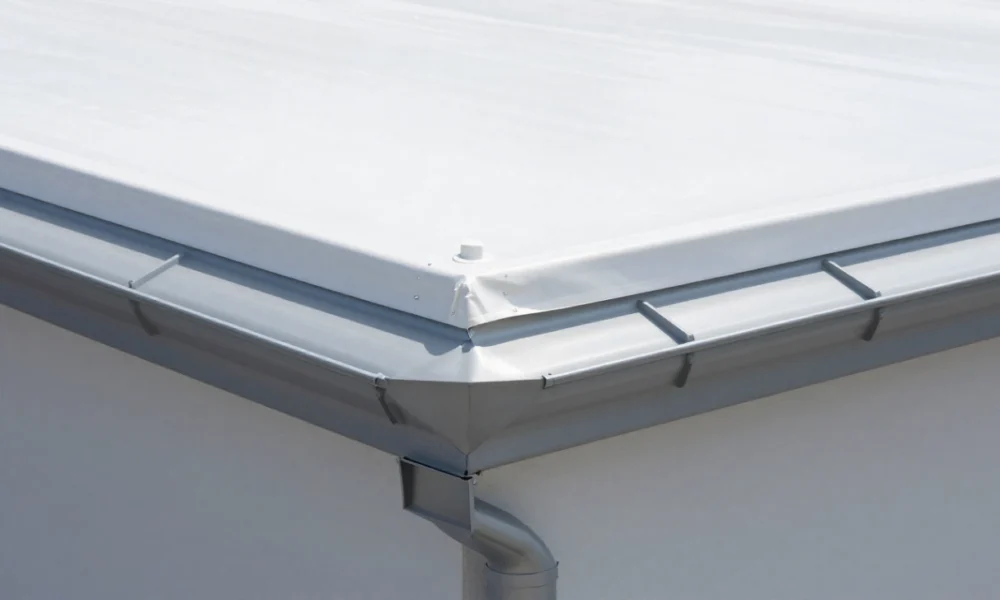
The white surface of a standard TPO membrane reflects a significant portion of solar heat, which reduces cooling loads in warm climates. Seams are heat-welded, creating strong, watertight bonds at the roof perimeter and around any penetrations — an important consideration where the membrane meets a drip edge or fascia flashing before water enters the gutter.
- Approximate installed cost: $5–$10 per square foot
- Expected lifespan: 15–25 years
- Best for: Energy-conscious property owners in warm climates; commercial and residential flat roofs requiring reliable seam integrity
Drawbacks: TPO requires specialized heat-welding equipment and trained installers. Improper welds at the roof edge are a common cause of water intrusion near gutter connections.
EPDM (Ethylene Propylene Diene Monomer)
EPDM is a synthetic rubber roofing membrane that has been used on flat roofs since the 1970s. It is one of the most proven flat roof materials available, with well-maintained installations regularly exceeding 20–30 years of service.
EPDM is typically black (though white EPDM is available for improved reflectivity) and is installed in large sheets using mechanical fasteners, adhesive, or ballast. Fewer seams compared to narrower membrane systems reduce potential leak points, including at roof edges where water transitions into box gutters or external downspouts.
The material is highly flexible, which helps it resist cracking during temperature swings — a key performance factor in climates with cold winters and hot summers. It is also one of the more DIY-accessible flat roofing materials, though professional installation is strongly recommended for perimeter details and drainage termination points.
- Approximate installed cost: $5–$10 per square foot
- Expected lifespan: 20–30 years (some installations exceed 40 years)
- Best for: Residential flat roofs, commercial buildings with heavy temperature variation, budget-conscious projects
Drawbacks: Standard black EPDM absorbs heat, which can increase cooling costs. EPDM adhesives are sensitive to petroleum-based products and direct contact with bituminous materials.
Built-Up Roofing (BUR)
Built-up roofing is one of the oldest and most established flat roof systems still in widespread use. A BUR system consists of three or more alternating layers of reinforcing fabric and hot-applied bitumen (asphalt), finished with a top layer of aggregate (typically gravel) or a granulated cap sheet.
The multi-layer construction gives BUR excellent waterproofing redundancy — if one layer is compromised, the layers beneath continue to protect the deck. This makes BUR a reliable companion to external gutter systems, as consistent waterproofing at the roof edge reduces the risk of water bypassing the drip edge and damaging the fascia board.
BUR is a heavier system than single-ply membranes, which may require structural assessment before installation on older buildings. Repairs can be more involved than with single-ply systems.
- Approximate installed cost: $5–$10 per square foot
- Expected lifespan: 15–30 years with proper maintenance
- Best for: Commercial buildings, flat roofs requiring high waterproofing redundancy, areas with heavy foot traffic
Drawbacks: Heavy installation — not suitable for all structures without load assessment. Hot-applied bitumen requires specialized equipment and carries a strong odor during installation.
Modified Bitumen
Modified bitumen is a more recent development that builds on traditional BUR technology. It consists of asphalt sheets modified with either APP (Atactic Polypropylene) or SBS (Styrene-Butadiene-Styrene) polymers, reinforced with fiberglass or polyester for added tensile strength.
APP-modified bitumen is applied by torch and performs well in high-UV environments. SBS-modified bitumen is cold-applied or self-adhering and performs better in colder climates due to its greater flexibility at low temperatures. A mineral-surfaced cap sheet on top helps reflect UV radiation and provides a degree of surface protection.
Modified bitumen typically installs in fewer layers than traditional BUR, making it quicker to apply. However, it is more vulnerable to punctures than TPO or EPDM, and regular inspection is needed to catch surface blistering before water infiltrates near gutter connection points.
- Approximate installed cost: $6–$12 per square foot
- Expected lifespan: 10–20 years
- Best for: Moderate climates; residential flat roofs with limited foot traffic
Drawbacks: Less durable than TPO or EPDM under repeated foot traffic. Requires periodic maintenance checks for cracks and blistering.
EPDM vs. TPO vs. Modified Bitumen: Quick Comparison
| Material | Approx. Cost (per sq ft) | Lifespan | UV Reflectance | DIY-Friendly | Best Climate |
|---|---|---|---|---|---|
| TPO | $5–$10 | 15–25 yrs | High (white) | No | Warm/Hot |
| EPDM | $5–$10 | 20–30+ yrs | Low (black) / Medium (white) | Partially | Cold/Variable |
| BUR | $5–$10 | 15–30 yrs | Low–Medium | No | All climates |
| Modified Bitumen | $6–$12 | 10–20 yrs | Medium | Partially | Moderate |
| Metal Roofing | $10–$20+ | 30–50 yrs | Medium–High | No | All climates |
Metal Roofing
Metal roofing on flat or low-slope structures is less common than membrane systems but is used in both residential and commercial applications where longevity and appearance are priorities. Galvanized steel, aluminum, and zinc are the most common metals used. Copper is available for premium installations and develops a natural patina that resists corrosion over time.
Metal performs well at directing water toward roof edges and gutters because of its rigid, non-porous surface. It is compatible with a wide range of gutter types, including K-style and box gutters, and pairs well with aluminum fascia gutters for a clean perimeter finish.
- Approximate installed cost: $10–$20+ per square foot
Expected lifespan: 30–50 years
Best for: Property owners prioritizing longevity and a distinctive appearance; commercial buildings with steeper low-slope designs
Drawbacks: Metal roofing is among the most expensive flat roof options. It can amplify noise during heavy rain and hail. Large hailstones may cause surface denting without proper gauge thickness.
Flat Roof Drainage: Gutters, Scuppers, and Internal Drains
The roofing membrane alone does not manage water — the drainage system must work with the membrane at every edge and penetration point.
Flat roofs typically drain through one of three methods:
1. External gutters
K-style and box gutters are the most common types attached to the fascia or eave of a flat-roofed structure. Box gutters have a larger capacity and suit commercial buildings or properties with large roof areas. The membrane must terminate correctly at a drip edge or gravel stop before water enters the gutter.
2. Scuppers
Scuppers are openings cut through the parapet wall at roof level, allowing water to drain off the edge or into a downspout. They require proper flashing at the scupper throat to prevent water from working behind the membrane.
3. Internal drains
Common on larger commercial flat roofs, internal drains connect to a piping system within the building. Proper slope — typically achieved through tapered insulation installed beneath the membrane — is critical to directing water toward the drain without pooling.
Regardless of which drainage method is used, the interface between the flat roof membrane and the drainage point is one of the most failure-prone areas on any flat roof. Poorly terminated edges, missing drip flashing, or incorrect gravel stops at the roof edge are common causes of water intrusion into fascia boards and exterior walls.
Gutter Materials That Work With Flat Roofs
The gutter material must be compatible with the roofing membrane chemistry and the volume of water your roof area generates. For flat and low-slope roofs, the most appropriate gutter materials include:
1. Aluminum
The most widely used gutter material for flat-roofed residential buildings. Aluminum is lightweight, corrosion-resistant, and compatible with all common flat roof membrane types. It is available in seamless form, which reduces leak points along the gutter run.
2. Galvanized steel
More durable than aluminum and better suited to commercial applications where box gutters must handle higher water volumes. Galvanized steel is heavier and may rust over time if the protective coating is damaged.
3. Copper
A long-lasting choice for premium residential applications. Copper gutters are durable, develop a protective patina, and require no painting. Note that copper is not chemically compatible with aluminum — hardware and connectors should match material to avoid galvanic corrosion.
4. PVC/Vinyl
Lower-cost option suitable for smaller residential flat roofs in moderate climates. Vinyl gutters can become brittle in very cold conditions and have a shorter lifespan (10–15 years) than metal alternatives.
How to Choose the Right Flat Roof Material
When selecting a flat roof membrane and drainage setup, four factors should guide the decision:
- Climate: TPO performs well in hot, sunny climates due to its reflective surface. EPDM handles cold temperatures better. Modified bitumen SBS formulations maintain flexibility in freeze-thaw cycles.
- Budget: BUR and EPDM offer lower upfront costs. TPO sits in the mid-range. Metal roofing carries the highest initial cost but the longest expected lifespan.
- Roof use: Roofs that need to support regular foot traffic (for HVAC access or rooftop equipment) perform best with BUR or modified bitumen. Single-ply membranes are more vulnerable to puncture under repeated foot traffic without protection boards.
- Drainage design: The membrane must terminate cleanly into the drainage system — whether that is an external aluminum gutter, a box gutter, or internal drains. A professional roofing contractor can confirm correct drip edge flashing and adequate slope through tapered insulation before installation begins.
A correctly installed flat roof membrane, properly terminated at a compatible drainage system, is one of the most cost-effective ways to protect a building from water damage over the long term.
For expert guidance on flat roof installation and gutter compatibility, consulting a licensed roofing contractor before committing to any material is always the safest approach.