

The Future of Car Technology: 2026 Trends in AI, Autonomy, and Sustainable Materials
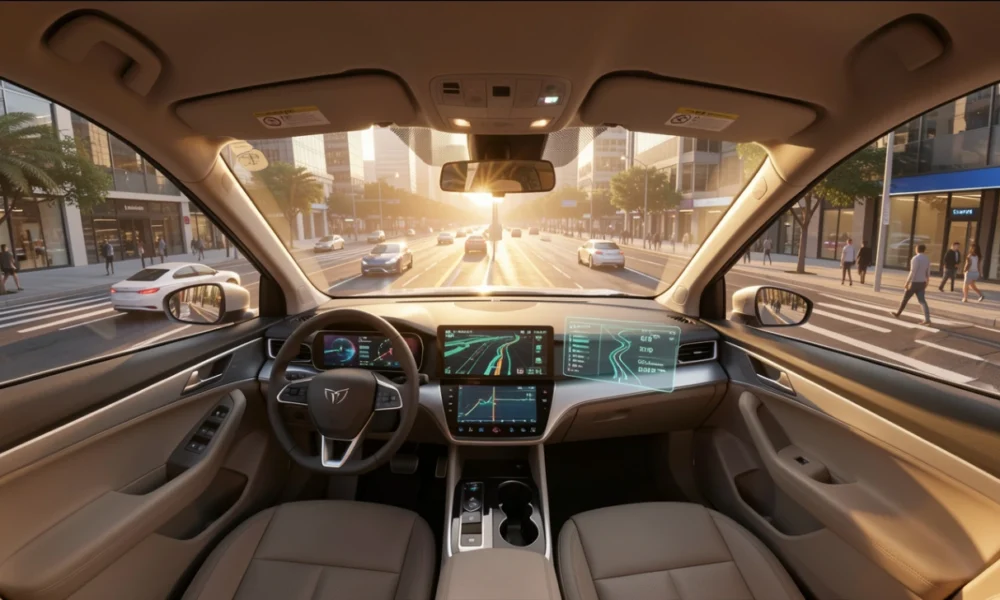
The automotive industry is undergoing a fundamental transformation, shifting its focus from pure electrification toward intelligence and software capability. At the 2026 Consumer Electronics Show (CES), the message was clear: the future of car technology is now defined by physical artificial intelligence (AI), software-defined vehicles (SDVs), and context-aware systems that interpret real-world conditions in real time.
Table Of Content
- The Shift Toward Physical AI and Software-Defined Vehicles
- Autonomous Vehicles: Two Paths to a Driverless Age
- Levels of Driving Automation
- Competing Visions: Robotaxis vs. Personal Autonomy
- The Technology Enabling Autonomy
- Connected Cars and V2X Communication
- Electrification and Market Realities
- Lightweight Materials and Sustainable Manufacturing
- Conclusion
These advancements are positioning cars as upgradable digital platforms rather than fixed hardware. This article examines the key technological trends—from autonomous driving and connected infrastructure to sustainable materials—that are shaping how we will move, work, and interact with our environment in the years ahead.
The Shift Toward Physical AI and Software-Defined Vehicles
The automotive industry’s priorities have evolved. With electric vehicle (EV) demand softening and regulatory pressures mounting, manufacturers are betting on AI-driven hardware and software to lower costs and enhance vehicle intelligence. This strategy centers on creating software-defined vehicles (SDVs), where features and functions are controlled by software and can be upgraded over the air (OTA), much like a smartphone.
This shift unlocks new possibilities for personalization and high-margin revenue through connected services and paid feature upgrades . The focus is no longer just on the vehicle’s physical specs but on its ability to learn, adapt, and integrate into a broader digital ecosystem. Cars are increasingly positioned as “experience spaces on wheels,” integrating displays, gaming, and AI personalization tied to entertainment ecosystems .
Autonomous Vehicles: Two Paths to a Driverless Age
Autonomous vehicle (AV) technology surged ahead at CES 2026, with the message that the driverless age is becoming a reality . The industry is progressing toward higher levels of automation, with two distinct approaches emerging.
Levels of Driving Automation
To understand the current landscape, it is helpful to recall the standard definition of automation levels:
| Level | What It Means |
|---|---|
| Level 0 | No self-driving features; the driver does everything. |
| Level 1 | Includes helper features like adaptive cruise control. |
| Level 2 | Can perform some tasks (e.g., steering and acceleration), but the driver must monitor the environment and stay alert. |
| Level 3 | Can handle most driving tasks in specific conditions; the driver must be ready to take over when requested. |
| Level 4 | Can drive itself in certain conditions (geofenced areas) without human intervention. |
| Level 5 | Can drive itself in any condition without any human help. |
Competing Visions: Robotaxis vs. Personal Autonomy
The path to full autonomy is being pursued through two primary business models, each with its own technological focus:
- The Geofenced Robotaxi Model (e.g., Waymo, Zoox): This approach relies on detailed, pre-mapped geographic areas (geofences). Vehicles use a suite of expensive sensors, including Light Detection and Ranging (LiDAR), to create a detailed 3D map of their surroundings, ensuring a highly polished and safe experience within a controlled environment . Thesensor and computing stack on each vehicle can cost an estimated US$100,000 over the car’s base price. Waymo, for example, operates fully autonomous, all-electric Jaguars across parts of Austin and other cities.
- The Personal Ownership Model (e.g., Tesla): This strategy aims to sell autonomy directly to consumers, allowing the car to be driven anywhere. It often relies on a camera-only system and AI software to navigate unmapped streets. While this approach offers greater scale and flexibility, it has also faced public scrutiny and safety concerns .
The Technology Enabling Autonomy
Both models depend on a complex technology stack. This includes high-performance 4D imaging radar, cameras, and LiDAR, which give the vehicle the “eyes” to see the road. These sensors are powered by low-power, high-fidelity AI System-on-a-Chip (SoC) circuits that enable Advanced Driver-Assistance Systems (ADAS) to process data and make real-time decisions.
NVIDIA, a key player in this space, unveiled its Alpamayo model at CES 2026. This 10-billion-parameter model is designed to help vehicles reason and navigate complex, unpredictable driving scenarios using “physical AI”. Such systems rely on large-scale simulation and synthetic data to learn how to react to situations that are difficult to capture in the real world.
Despite the progress, challenges remain. Incidents such as a Waymo robotaxi striking a child near a school in Santa Monica serve as reminders that autonomous systems can still struggle in complex, unpredictable environments. Furthermore, determining liability in a crash and ensuring cybersecurity are ongoing concerns that the industry must address.
Connected Cars and V2X Communication
Connectivity is the foundation upon which safe and efficient autonomous driving is built. Vehicle-to-Everything (V2X) communication allows cars to share real-time information with other vehicles, infrastructure, and road users. The 5G Automotive Association (5GAA) has been demonstrating the practical applications of these technologies, which are critical for improving traffic management and road safety .
| Type of V2X | What It Does |
|---|---|
| Vehicle-to-Vehicle (V2V) | Allows cars to communicate directly with each other about their position, speed, and heading to predict potential dangers. |
| Vehicle-to-Infrastructure (V2I) | Let’s cars talk to traffic lights, road signs, and toll booths to optimize traffic flow and enable automated transactions. |
| Vehicle-to-Pedestrian (V2P) | Helps cars detect and communicate with people walking or using other devices to keep them safe, especially in low-visibility situations. |
Recent demonstrations have showcased several transformative capabilities. Connected tolling allows vehicles to communicate with roadside units to complete transactions automatically, reducing congestion and improving safety. To ensure connectivity in remote areas, non-terrestrial networks (NTN) using satellite links can keep vehicles fully operational for telematics, emergency services, and infotainment where traditional networks fail. Furthermore, AI-enabled roadside sensors can share information about hazards and unequipped road users with connected vehicles via Cellular Vehicle-to-Everything (C-V2X) technology, providing real-time safety alerts.s
Electrification and Market Realities
While AI and autonomy took center stage at CES 2026, electrification remains a core component of the industry’s evolution, though its trajectory has become more nuanced. Global sales of battery electric vehicles (BEVs) are projected to grow by 19% in 2026, reaching approximately 17.4 million units, which would represent about 19% of the global vehicle sales market . However, overall global light vehicle sales are expected to remain relatively flat at around 91.8 million units due to economic pressures, supply chain uncertainties, and high interest rates . This has led to a recalibration of strategies. Hybrids and plug-in hybrids are gaining traction as a bridge for consumers and markets where charging infrastructure or readiness is lacking . Manufacturers are also facing significant supply chain challenges, including a potential Dynamic Random-Access Memory (DRAM) chip shortage in 2026 as AI demand diverts supply, which could cause automotive-grade DRAM prices to spike by 70–100%. Despite these hurdles, improvements in battery technology, such as the spread of the North American Charging Standard (NACS) and advancements in wireless charging, continue to address range anxiety and improve the ownership experience .
Lightweight Materials and Sustainable Manufacturing
To improve efficiency, performance, and sustainability, carmakers are increasingly turning to advanced lightweight materials and innovative manufacturing processes. The goal is to reduce overall vehicle weight to improve fuel efficiency or EV range without compromising safety.
While traditional materials like aluminum, carbon fiber, and magnesium are still used, a significant trend is the move toward sustainable and bio-based composites. For instance, SGL Carbon and the BMW Group received a JEC Innovation Award for their Natural Fiber Composites project. They developed production-ready, flax-based composite components that achieve approximately 40% lower CO₂ emissions during production compared to conventional carbon-fiber-reinforced polymer (CFRP) .
| Mateial | Typical Applications | Benefits |
|---|---|---|
| Aluminum | Body panels, chassis parts | Lighter weight, improved fuel efficiency, and recyclable. |
| Carbon Fiber | Body panels, structural parts | Very high strength-to-weight ratio, enhances performance. |
| Natural Fiber Composites | Interior and exterior visible parts (e.g., BMW M project) | Sustainable, lower production emissions (up to 40% less CO₂), good surface quality. |
| Sustainable Plastics | Underbody protection for EVs (e.g., protECOlight project) | Significant weight savings (replacing ~30kg of aluminum), improved CO₂ footprint, enhanced impact tolerance. |
In addition to new materials, manufacturing techniques are evolving. The protECOlight project, involving partners like Audi and Fraunhofer, is developing sustainable, fiber-reinforced plastic underbody protection structures for battery-electric and hydrogen vehicles. These structures aim to replace traditional, heavy aluminum designs (which can weigh around 30 kg) with lighter composite solutions, thereby reducing the vehicle’s CO₂ footprint across its entire lifecycle.
Furthermore, by-wire technologies, which replace mechanical connections with electronic controls (e.g., steer-by-wire, brake-by-wire), are gaining ground in premium vehicles, allowing for more flexible designs and integration with ADAS.
Conclusion
The future of car technology is no longer a distant vision but a rapidly unfolding reality. The industry is pivoting from a singular focus on hardware and electrification to a more complex, integrated future defined by software, AI, and connectivity. We are moving toward a world where cars are intelligent, upgradable platforms that interact seamlessly with their environment and their passengers.
- Autonomous driving is progressing along two distinct paths, with geofenced robotaxis offering a near-term reality in specific cities and personal autonomy advancing through sophisticated AI.
- Connectivity is weaving vehicles into a smart mobility ecosystem, promising safer and more efficient roads through real-time data exchange.
- Electrification is evolving pragmatically, with hybrids complementing BEVs as the industry adapts to market demands and infrastructure readiness.
- Material science is embracing sustainability, with innovations in natural fiber composites and lightweight recycled plastics paving the way for greener manufacturing and improved vehicle efficiency.
As these technologies mature, they promise to reshape not just how we drive, but how we live, work, and interact with our urban environments. The focus will increasingly be on scalable execution, user trust, and the seamless integration of the car into our digital lives.