

Most Iconic Gustav Klimt’s Oil Paintings: Style, Symbolism, and Legacy
Gustav Klimt (14 July 1862 – 6 February 1918) was an Austrian symbolist painter and a founding member of the Vienna Secession movement. Born in Baumgarten, near Vienna, to a goldsmith father, Klimt trained at the Vienna School of Applied Arts (Kunstgewerbeschule) from 1876, where he studied architectural painting before developing one of the most recognizable styles in modern European art. His work helped define Art Nouveau across the continent, and his oil paintings remain among the most reproduced and studied works of the late 19th and early 20th centuries.
Table Of Content
- The Golden Phase: Klimt’s Defining Period
- The Kiss (1907–1908)
- Portrait of Adele Bloch-Bauer I (1907)
- Judith and the Head of Holofernes (1901)
- The Beethoven Frieze (1902)
- Landscapes: A Less Discussed Body of Work
- The Tree of Life (1905–1909)
- Fräulein Lieser (1916–1917)
- Klimt’s Artistic Influence and Institutional Legacy
- What Makes Klimt’s Oil Paintings Distinctive
- Where to See Klimt’s Oil Paintings Today?
Klimt’s mature style drew on an eclectic range of sources: Byzantine mosaics, Egyptian ornamentation, Minoan motifs, Classical Greek art, and Japanese Rimpa school woodblock prints. These influences, combined with his use of gold and silver leaf to produce paintings of unusual decorative density and psychological weight.
The Golden Phase: Klimt’s Defining Period
Between roughly 1903 and 1909, Klimt entered what art historians call his Golden Phase — the period when he integrated gold and silver leaf directly into his oil paintings, producing some of the most opulent surfaces in Western art. Works from this period include The Kiss, Portrait of Adele Bloch-Bauer I, Water Serpents II, and Danaë. The aesthetic draws heavily from the Byzantine mosaics Klimt encountered during trips to Ravenna and Venice, and the gilded effect gave his figures an almost sacred, icon-like quality.
The femme fatale recurs throughout this period as a dominant theme — powerful, sensual women who occupy the visual and psychological center of each composition. Klimt’s frank treatment of the female body and his use of overt sexual symbolism made him a controversial figure in Vienna’s cultural establishment, but it also secured him the most significant private commissions of his career.
The Kiss (1907–1908)
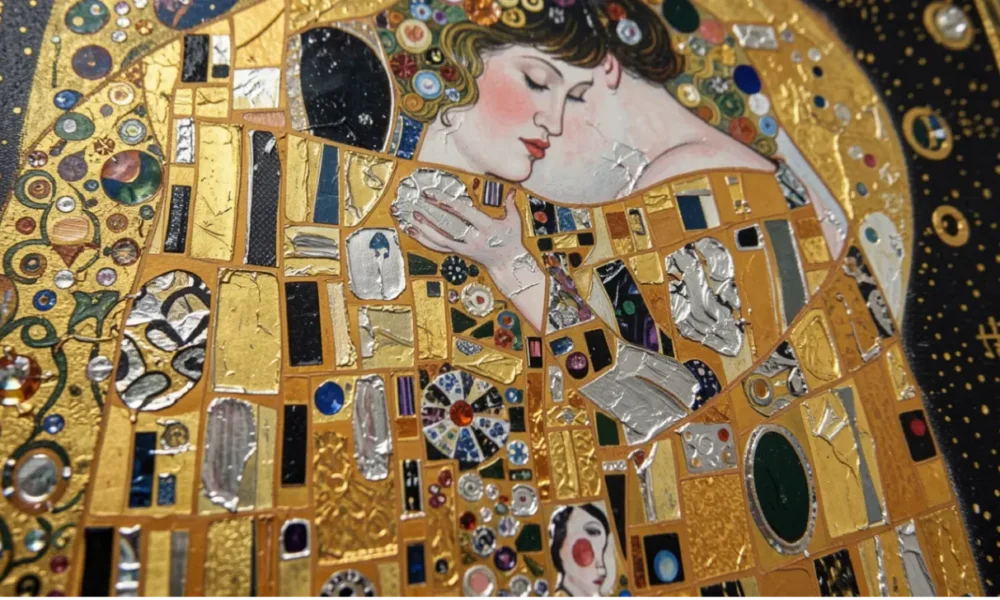
The Kiss, held at the Österreichische Galerie Belvedere in Vienna, is Klimt’s most recognized work and a centerpiece of the Art Nouveau canon. Painted in oil, gold, and silver leaf on canvas, it depicts a couple locked in an embrace on a flower-covered ledge, their bodies almost entirely obscured beneath a cascade of geometric and floral patterns.
The male figure is draped in rectangles and angular forms, while the woman’s robe is decorated with circular shapes and flowers — a deliberate visual contrast that several art historians read as a male-female dichotomy drawn partly from the influence of vertical Japanese pillar prints (hashira-e), which Klimt collected. The figures are confined to a narrow central strip of canvas, with their heads pressing toward the upper border, a compositional technique that increases the sense of enclosure and intimacy.
Klimt left the identities of the two figures deliberately ambiguous. Studies for the work suggest the male figure may carry autobiographical elements, and Emilie Louise Flöge — Klimt’s lifelong companion and an Austrian fashion designer — is among those proposed as the model for the woman, though this is not confirmed. The ambiguity is likely intentional: by withholding identity, Klimt gave the image a universal quality that has sustained its appeal for over a century.
Portrait of Adele Bloch-Bauer I (1907)
This portrait, completed in 1907 after approximately four years of studies, is now held permanently at the Neue Galerie in New York. It depicts Adele Bloch-Bauer — wife of the Viennese sugar industrialist Ferdinand Bloch-Bauer and one of Klimt’s most significant patrons — against a surface of gold leaf in which her figure nearly dissolves into the ornamental background.
The composition draws on Egyptian and Byzantine sources, and the painting is technically among the most complex Klimt produced. Gold and silver leaf were applied across much of the surface, with the figure’s dress and the background treated as a continuous decorative field rather than separated into figure and ground.
The painting has a significant legal history. Following the Nazi annexation of Austria in 1938, Ferdinand Bloch-Bauer fled the country and the paintings were seized. After Ferdinand’s death in 1946, ownership passed to his heirs, including his niece Maria Altmann, who in 2000 filed a lawsuit to reclaim the work from the Austrian state. The case reached the United States Supreme Court and was ultimately resolved in 2006 in the family’s favor. That year, Altmann sold Portrait of Adele Bloch-Bauer I to American collector Ronald S. Lauder for $135 million — a record price for any painting at the time. Lauder donated the work to the Neue Galerie, the museum for German and Austrian art he co-founded in New York. The case was dramatized in the 2015 film Woman in Gold, starring Helen Mirren as Altmann.
Judith and the Head of Holofernes (1901)
Completed in 1901, Judith and the Head of Holofernes is an early example of Klimt’s interest in the femme fatale archetype. The painting depicts the biblical heroine Judith — eyes half-closed, expression disturbingly calm — holding the severed head of the Assyrian general Holofernes. Rather than portraying Judith as a heroic or mournful figure, Klimt presents her as sensual and powerful, her partially exposed body adorned with a golden collar that echoes the Byzantine ornamental tradition.
The painting is housed at the Österreichische Galerie Belvedere in Vienna. It remains one of Klimt’s most psychologically complex works, and its depiction of female authority and desire drew both admiration and hostile criticism when it was first exhibited.
The Beethoven Frieze (1902)
Created for the 14th Vienna Secession exhibition in 1902, the Beethoven Frieze is a monumental work spanning approximately 34 meters across three walls of the Secession building in Vienna. Executed in casein paint, gold leaf, and mixed media (rather than pure oil), it was conceived as a temporary installation but survived and is now on permanent display in the Secession’s basement.
The frieze is structured as a visual interpretation of Beethoven’s Ninth Symphony — specifically, Richard Wagner’s interpretation of that symphony as a celebration of the transformative power of art. The composition moves through figures representing human longing and hostile forces — including The Three Gorgons and a figure representing Sickness, Madness, and Death — before culminating in The Embrace, a scene of reunion and joy. The Beethoven Frieze is one of the clearest expressions of the Secession’s Gesamtkunstwerk ideal: the total work of art that integrates architecture, painting, and music.
Landscapes: A Less Discussed Body of Work
Alongside his figurative paintings, Klimt produced a substantial number of landscapes, primarily during summer stays at the Attersee in the Austrian Lake District with Emilie Flöge and her family. Works such as The Park (1910), Garden with Sunflowers (1906), and The Avenue in Schloss Kammer Park (1912) are characterized by an almost aerial perspective — fields and forests compressed into flat, patterned surfaces with no visible horizon line.
Garden with Sunflowers, painted during the Golden Phase, incorporates the same decorative sensibility as his figurative work, treating the flower bed as an ornamental field of color and form. Klimt reportedly used a telescope to observe sections of the landscape from a distance before painting them, which may account for the telephoto compression characteristic of these works.
The Tree of Life (1905–1909)
The Tree of Life was created as part of the Stoclet Frieze — a commission from the Belgian industrialist Adolphe Stoclet for his palatial residence, the Palais Stoclet in Brussels, designed by architect Josef Hoffmann. Executed in enamel, semi-precious stones, gold, and other materials, the frieze is technically not an oil painting, but the cartoons and studies Klimt produced for it are closely related to his Golden Phase paintings in style and symbolism.
The central motif — a spiraling tree with gilded, swirling branches — is one of Klimt’s most celebrated images and has become almost as recognizable as The Kiss. The composition represents the continuity of life and the interconnection of living things, rendered in the richly ornamented language of the late Golden Phase.
Fräulein Lieser (1916–1917)
Painted in the final years of Klimt’s life, Fräulein Lieser was one of several works that remained unfinished at the time of his death in February 1918. The painting depicts a young woman in a floral garment against an ornately patterned background. Lost for decades and long listed as a missing work, it resurfaced and was sold at auction in Vienna in April 2024 for approximately €30 million (around $32 million), underscoring the sustained market demand for Klimt’s paintings. The sale attracted international attention and was reported by major cultural institutions and auction houses.
Klimt’s Artistic Influence and Institutional Legacy
Klimt was a mentor to several younger Austrian artists, most notably Egon Schiele, whose expressionist style diverged sharply from Klimt’s decorative approach but shared the frank treatment of the human body. Klimt also provided material support to Schiele early in the younger artist’s career.
Klimt died on 6 February 1918, from pneumonia following a stroke — compounded by the Spanish flu epidemic that swept Europe at the time. He left a number of major works unfinished.
Today, his paintings are held in permanent collections at the Österreichische Galerie Belvedere in Vienna, the Leopold Museum in Vienna, and the Neue Galerie in New York. His works have shown consistent value growth at auction: according to Sotheby’s Mei Moses data, the average compound annual return for Klimt works resold at auction between 2003 and 2017 was 4.9%, with 76.3% of tracked works increasing in value.
Klimt’s broader cultural influence extends into fashion — designers including John Galliano (for Christian Dior’s Spring–Summer 2008 haute couture collection) and Alexander McQueen (2013 collection) have cited his work as a direct source. His paintings have also been the subject of major biographical films, including Klimt (2006), starring John Malkovich, and the documentary Stealing Klimt (2007).
What Makes Klimt’s Oil Paintings Distinctive
Several technical and conceptual elements set Klimt’s oil paintings apart from his contemporaries:
- Gold and silver leaf integration: Used not as background embellishment but as a structural element fused with oil paint, producing surfaces of unusual visual complexity.
- Flat, patterned space: Klimt frequently collapsed depth, treating backgrounds as decorative planes rather than receding environments — drawing on Japanese woodblock techniques and Byzantine mosaic tradition.
- Symbolic figure types: Recurring archetypes, including the femme fatale, the maternal figure, and allegories of love, death, and desire, appear across his work with consistent visual language.
- Ornamental linework: Spirals, geometric repetitions, and sinuous curves derived from Art Nouveau are embedded throughout his compositions.
- Psychological ambiguity: Figures often carry multiple possible readings — erotic and spiritual, tender and threatening — which contribute to the lasting interpretive interest in his work.
Where to See Klimt’s Oil Paintings Today?
The largest concentration of Klimt’s original paintings is at the Österreichische Galerie Belvedere in Vienna, which holds The Kiss, Judith and the Head of Holofernes, and numerous landscapes and allegorical works. The Leopold Museum, also in Vienna, holds additional figurative works and drawings. Outside Austria, the Neue Galerie New York is home to Portrait of Adele Bloch-Bauer I, which is on permanent display and among the most visited works in the museum’s collection.
Gustav Klimt produced an estimated 230 paintings over his career, of which over 160 are currently documented. His oil paintings — from the intimate gold-leaf portraits to the expansive landscape studies — represent one of the most coherent and distinctive bodies of work produced during the Art Nouveau period, and their presence in major museum collections worldwide ensures they remain central to the study of late 19th and early 20th century European art.