How to Become a 3D Environment Artist: Skills, Portfolio, and Industry Outlook for 2026
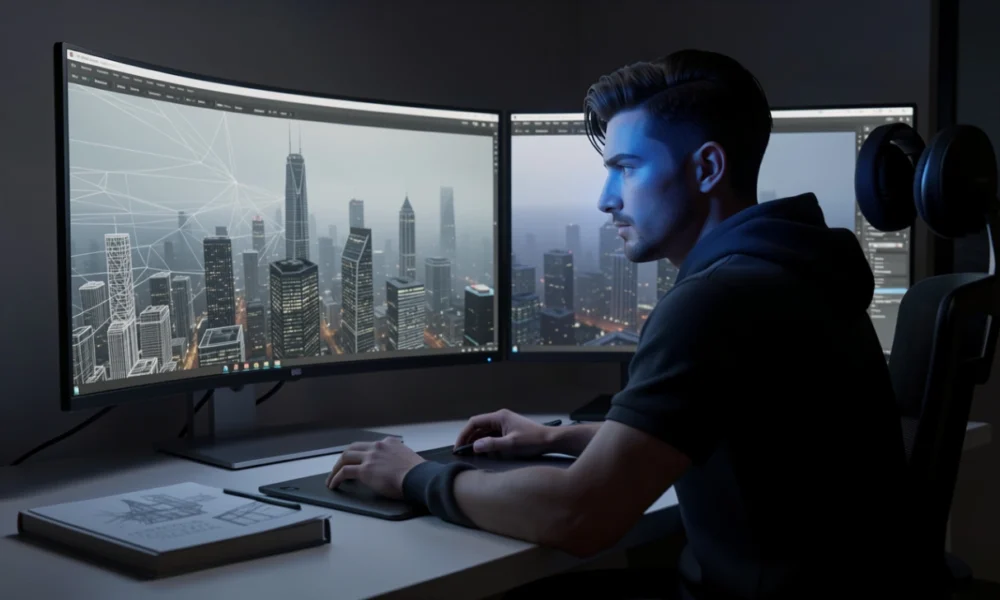
The immersive worlds of modern video games and visual effects (VFX) films are not simply drawn or programmed; they are built. Behind every sprawling landscape, intricate cityscape, and believable digital interior is a 3D environment artist. This role is distinct from character modeling or general 3D animation, focusing specifically on the creation of the spaces where action and stories unfold.
Table Of Content
If you are considering a career in this field, understanding the specific skills, tools, and industry expectations is the first step. This guide outlines the core responsibilities, required competencies, and current industry landscape for 3D environment artists, providing a roadmap for aspiring professionals.
The Core Role of a 3D Environment Artist
A 3D environment artist is a digital sculptor and architect responsible for constructing the virtual worlds seen in video games, films, and immersive experiences like virtual reality (VR). Their work forms the backdrop and context for the narrative, establishing mood, guiding gameplay, and creating a believable space for characters to inhabit.
The specific tasks of an environment artist can vary significantly between industries:
- In Game Development: The focus is on creating assets that are not only visually compelling but also optimized for real-time rendering. This involves working within the technical constraints of a game engine like Unreal Engine 5 to ensure environments run smoothly without sacrificing visual fidelity. Artists must consider gameplay flow, collaborating closely with level designers to ensure the environment supports the player’s experience .
- In Visual Effects (VFX) and Animation, the priority is often photorealism or a specific stylized look for a linear narrative. Artists may use a broader range of techniques, including 2.5D projections (a mix of 2D matte painting projected onto simple 3D geometry) and full 3D asset builds. The goal is to create seamless set extensions or entire digital worlds that integrate flawlessly with live-action footage or animated characters.
Despite these different applications, the foundational goal remains the same: to construct compelling, coherent, and high-quality 3D spaces.
Essential Technical Skills and Software Proficiency
Proficiency with industry-standard software is a fundamental requirement. The specific toolset can vary, but a professional 3D environment artist is expected to be skilled in several core areas.
- 3D Modeling & Sculpting: This is the foundation. Artists need to be proficient in creating 3D assets, from large structures like buildings to small props like rocks and foliage. Key tools include Autodesk Maya and 3ds Max, which are industry standards for modeling and animation, and Blender, a powerful, free, and increasingly popular alternative. For high-resolution sculpting of complex organic shapes, ZBrush is the essential tool .
- Texturing and Shading: Applying surface detail, color, and material properties is what makes models look realistic or stylized. Artists use software like Substance 3D Painter and Substance 3D Designer to paint textures directly onto 3D models and create complex, procedural materials . A strong understanding of Physically Based Rendering (PBR) workflows is critical for ensuring materials realistically react to lightame Engines and Real-Time Rendering. For game and immersive media work, deep knowledge of a game engine is non-negotiable. Unreal Engine 5 is a dominant force, used for both game development and virtual film production. Artists use it to assemble their assets, set up lighting, and build the final, playable, or explorable world
- Compositing and 2D Skills: In VFX workflows, tools like Nuke are essential for integrating rendered 3D elements into live-action footage. Strong skills in Adobe Photoshop are also fundamental for creating textures, concept art, and matte paintings.
Emerging Technical Knowledge: As of 2026, familiarity with procedural generation tools (like Houdini), photogrammetry, and even AI-assisted workflows is becoming a significant advantage, helping artists work more efficiently and create more complex scenes.
Foundational Artistic Principles
Technical skill with software is only half of the equation. A successful 3D environment artist must also have a strong grasp of core artistic principles.
- Composition and Spatial Reasoning: Knowing how to arrange elements within a scene to guide the viewer’s eye and create a sense of balance and purpose. This includes understanding scale, proportion, and how the environment’s layout affects the viewer’s experience
- Lighting and Color Theory: Lighting sets the mood, directs attention, and defines the time of day. A deep understanding of how light interacts with different materials, combined with color theory, is essential for creating atmosphere and visual harmony.
- Architecture and World-Building: A good environment tells a story. Artists benefit from understanding architectural styles, city planning, and the logic of how structures are built and used. This knowledge allows them to create spaces that feel lived-in, functional, and believable
Building a Portfolio and Starting Your Career
For aspiring 3D environment artists, the portfolio is the single most important tool for getting hired. It is a visual resume that must demonstrate both technical ability and artistic sensibility.
Key Portfolio Principles:
- Showcase Cohesive Environments: Rather than a collection of unrelated objects, include several completed scenes that show you can build a complete, believable world .
- Demonstrate Your Process: Include breakdowns that show the steps involved in creating your scenes—from the initial blockout and concept, through to the final textured and lit model. This shows potential employers how you work and solve problems .
- Highlight Versatility and Specialization: Show a range of skills (modeling, texturing, lighting) while also highlighting a particular strength or style that makes your work stand out. Include personal projects that showcase your creativity and artistic sensibilities .
Career Pathways: The demand for environmental artists spans multiple industries. According to recent job postings, common entry-level and senior roles include Environment Artist, 3D Asset Artist, and Matte Painter. With experience, one can advance to Senior or Lead Environment Artist roles, overseeing teams and defining the visual direction of a project
Salaries vary widely based on experience, location, and industry. For example, a senior role at a major studio like Industrial Light & Magic can command a salary range of $150,900 to $193,200 per year, while a staff position at a game developer might range from $90,000 to $150,000 .These figures reflect the high value placed on specialized skills in this field.
Continuous Learning: The tools and techniques for 3D environment art evolve rapidly. Staying current is a necessity. Engaging in continuous learning through online tutorials, specialized workshops, and courses from institutions like the University of Warwick or vocational schools can help artists refine their skills and stay competitive .
onclusion
Becoming a 3D environment artist is a challenging but achievable goal that requires a balanced blend of artistic talent and technical proficiency. It demands a passion for building worlds, an eye for detail, and a commitment to lifelong learning in a fast-paced industry. By mastering the core software, grounding yourself in artistic fundamentals, and crafting a compelling portfolio that tells the story of your skills, you can position yourself for a rewarding career building the worlds of tomorrow.