How to Choose the Right Truck for Hire: A Complete Guide to Capacity, Types, and Costs
Selecting an appropriate truck for hire requires understanding your specific transport requirements and matching them to the right vehicle specifications. Whether you’re relocating a household, transporting business inventory, or moving construction materials, making an informed choice can prevent costly mistakes and ensure efficient operations.
Table Of Content
- Understanding Weight Ratings and Load Capacity
- Truck Types and Their Applications
- Rental Agreement Terms and Conditions
- Insurance Coverage and Protection Options
- Cost Considerations and Budget Planning
- Pre-Rental Inspection and Documentation
- Safe Loading and Operation Practices
- Selecting the Right Company
- Final Considerations
This guide provides practical insights into key factors, including payload capacity, vehicle classifications, rental agreements, insurance requirements, and safety protocols to help you choose the most suitable truck for your needs.
Understanding Weight Ratings and Load Capacity
Before selecting a truck, you must understand three fundamental weight measurements that determine what a vehicle can safely transport.
Gross Vehicle Weight Rating (GVWR) represents the maximum weight a truck can handle when fully loaded, including the vehicle itself, cargo, passengers, and fuel. This manufacturer-specified limit appears on the driver’s side door jamb placard and cannot be exceeded without safety and legal consequences.
Payload capacity is calculated by subtracting the truck’s curb weight (empty weight with fluids) from the GVWR. For example, if a truck has a GVWR of 10,000 pounds and weighs 6,500 pounds empty, the payload capacity is 3,500 pounds. This figure includes everything you plan to load—cargo, equipment, and passengers.
Cubic footage matters as much as weight capacity. A truck might have adequate weight capacity but insufficient space for bulky items. Rental trucks typically range from 400 cubic feet (cargo vans) to 1,700 cubic feet (26-foot box trucks). Compare your cargo volume against these specifications to prevent loading issues.
Calculate your requirements before contacting rental companies. Weigh or estimate the total cargo weight, measure oversized items, and count the number of boxes or pallets. This preparation ensures you select a truck with appropriate capacity margins, typically 10-15% above your calculated needs to accommodate loading inefficiencies and unexpected additions.
For vehicles exceeding 26,000 pounds GVWR, drivers require a Commercial Driver’s License (CDL) in most jurisdictions. Standard truck rentals stay below this threshold, allowing operation with a regular driver’s license.
Truck Types and Their Applications
Rental fleets include several distinct vehicle categories, each designed for specific hauling scenarios.
- Cargo vans (9-12 feet) hold approximately 400-450 cubic feet and 3,500 pounds. These work well for small business deliveries, studio apartment moves, or transporting furniture pieces through urban areas where parking and maneuverability matter.
- Small box trucks (10-14 feet) provide 450-700 cubic feet with 3,000-4,000 pound capacities. They suit one-bedroom apartments, small office relocations, or regional delivery routes where compact dimensions simplify navigation.
- Medium box trucks (15-17 feet) offer 850-900 cubic feet and can carry 5,000-6,000 pounds. These handle two to three-bedroom apartments, moderate business inventory moves, or construction material transport for mid-sized projects.
- Large box trucks (20-22 feet) accommodate 1,000-1,200 cubic feet with capacities reaching 10,000 pounds. They’re appropriate for three to four-bedroom homes, commercial deliveries, or moving heavy machinery and equipment.
- Extra-large box trucks (24-26 feet) represent the largest commonly rented vehicles at 1,600-1,700 cubic feet and 10,000-12,000 pound capacities. These handle complete household moves (four bedrooms or more), large-scale business relocations, or substantial construction loads.
- Flatbed trucks excel when loading requires overhead crane access or when transporting materials like lumber, steel, or landscaping supplies that won’t fit in enclosed spaces. Their open design simplifies loading oversized or irregularly shaped cargo.
- Refrigerated trucks maintain temperature-controlled environments for perishable goods, pharmaceuticals, or temperature-sensitive electronics during transport. Rental companies typically require additional documentation and training for these specialized vehicles.
Choose based on your actual requirements rather than defaulting to larger trucks “just in case.” Oversized vehicles cost more to rent and consume significantly more fuel—a 26-foot truck averages 8-10 miles per gallon compared to 12-15 mpg for smaller options.
Rental Agreement Terms and Conditions
Rental contracts contain specific provisions that directly affect costs and legal responsibilities.
Duration options typically include daily, weekly, or monthly rates. Daily rentals suit quick local moves, while weekly rates offer better value for longer projects. Some companies provide hourly rentals for very short-term needs. Compare the total cost across different time frames—renting for four days often costs nearly as much as a full week.
Mileage policies vary significantly between providers. Local rentals often include unlimited mileage within a specified radius, while one-way or long-distance rentals charge per mile after an initial allowance. Per-mile charges range from $0.50 to $2.50 depending on vehicle size and distance. Calculate your expected mileage and compare total costs including these charges.
One-way versus round-trip rentals serve different purposes. Round-trip requires returning the truck to the original location, ideal for local moves or projects near the rental facility. One-way rentals allow drop-off at different locations, essential for long-distance relocations but typically more expensive with additional fees ranging from $100 to several hundred dollars.
Fuel policies generally require returning trucks with the same fuel level as pickup. Some companies offer prepaid fuel options, but these rarely provide better value than refueling yourself before return. Confirm the fuel type—diesel versus gasoline—as using incorrect fuel causes severe engine damage and liability.
Age and license requirements typically mandate drivers be 18-25 years old (varies by company and location) with valid licenses. Some companies restrict rentals to drivers 21 or older for larger trucks. International license holders should confirm acceptance policies beforehand.
Return procedures include specific time windows and location requirements. Late returns incur additional daily charges, often at premium hourly rates exceeding the regular rental fee. Grace periods vary from 30 minutes to several hours.
Read contracts thoroughly before signing. Clarify provisions about mileage limits, acceptable use restrictions, geographic boundaries, and penalties for contract violations.
Insurance Coverage and Protection Options
Understanding insurance options prevents financial exposure if accidents or damage occur.
Basic liability coverage included in most rentals protects third parties for bodily injury or property damage you cause while operating the truck. Minimum coverage typically ranges from $100,000 to $1,000,000 depending on vehicle size and rental company policy. This doesn’t cover damage to the rental truck itself.
Collision Damage Waiver (CDW) or Loss Damage Waiver (LDW) releases you from financial responsibility if the rental truck is damaged or stolen during the rental period. Despite the name, it’s not insurance but a waiver of liability. Daily costs range from $15 to $45 depending on vehicle size. The waiver typically excludes certain scenarios including negligence, unauthorized drivers, or prohibited uses.
Supplemental Liability Protection (SLP) increases third-party liability coverage beyond basic minimums, often to $1,000,000 or more. This additional layer costs $10-$40 per day and protects your personal assets if claims exceed the basic coverage limit.
Personal Accident Insurance (PAI) covers medical expenses and accidental death for the driver and passengers. If your existing health or auto insurance provides adequate coverage, this option may be redundant.
Cargo coverage protects the goods being transported against damage or loss during transit. Basic rental contracts typically don’t include cargo protection. If transporting valuable items, verify whether your homeowner’s, renter’s, or business insurance extends coverage to goods in rental vehicles.
Before purchasing rental company insurance, examine your existing policies:
- Personal auto insurance may extend to rental trucks, though many policies exclude vehicles exceeding certain weights or used for business purposes
- Credit cards sometimes provide collision coverage for rentals, but typically exclude trucks and cargo vans
- Business insurance should cover commercial activities if you’re using the truck for business purposes
- Homeowner’s or renter’s insurance might cover personal belongings during a move
Contact your insurance provider to confirm coverage specifics before declining rental company options. Operating without adequate protection exposes you to substantial financial risk.
Cost Considerations and Budget Planning
Accurate budgeting requires accounting for all expenses beyond the base rental rate.
Base rental rates vary by truck size, rental duration, and location. Small cargo vans start around $20-40 per day, while 26-foot trucks range from $40-150 daily depending on the season and availability. Weekly rates typically equal 5-6 daily rates, providing meaningful savings.
Mileage charges add $0.50-2.50 per mile above included allowances. A 500-mile one-way move could add $250-1,250 to the total cost depending on the rate structure. Account for actual driving distance plus potential detours.
Fuel costs represent a significant expense often underestimated by renters. A 26-foot truck traveling 300 miles at 8 mpg with $3.50 per gallon diesel costs approximately $130 in fuel alone. Smaller trucks reduce this proportionally but still require budgeting.
Insurance and protection products add $25-100 per day depending on coverage selections. For a week-long rental, these options can add $175-700 to total costs.
Equipment rentals including furniture dollies, moving blankets, tie-down straps, and loading ramps typically cost $5-15 per item per day. Many renters need multiple equipment pieces, adding $50-150 for typical moves.
Additional driver fees of $10-15 per day apply if multiple people will operate the truck. Some companies waive this for spouses or immediate family members.
Deposit requirements range from $100-500 depending on truck size and payment method. Credit cards typically require lower deposits than debit cards. Deposits return within 5-10 business days after the rental concludes without issues.
Hidden charges to watch for include:
- Environmental or administrative fees ($5-25)
- Airport or downtown location surcharges (10-20% additional)
- After-hours pickup or drop-off fees ($25-50)
- Cleaning fees if returning the truck excessively dirty ($50-150)
- Tolls if using transponder services (toll amount plus processing fees)
- Replacement charges for missing equipment ($25-100 per item)
Request complete quotes from multiple companies including all applicable fees and charges. Compare the total projected cost rather than just advertised rates. Booking in advance typically secures better rates, especially during peak moving seasons (May-September and month-end dates).
Reserve mid-week pickup and return dates when possible, as weekend availability tightens during busy periods. Tuesday through Thursday bookings often yield better rates and selection.
Pre-Rental Inspection and Documentation
Thorough vehicle inspection before departure protects against liability for pre-existing damage.
Exterior inspection should document every scratch, dent, or damage using photos or video with timestamps. Check all panels, bumpers, mirrors, lights, and door operation. Note existing damage on the rental agreement before signing, ensuring the company representative acknowledges and initials each item.
Interior inspection includes checking seat condition, dashboard functionality, cleanliness, and existing cargo area damage. Test all lights, signals, windshield wipers, heating, and air conditioning. Verify that required equipment (jack, spare tire, fire extinguisher if applicable) is present and functional.
Loading area assessment involves checking for protruding nails, damaged floors, or compromised tie-down anchors. These defects can damage cargo and should be documented before loading begins.
Mileage and fuel verification must match the rental agreement. Take photos of the odometer and fuel gauge at pickup and return to prevent disputes.
Conduct a similar inspection at return, documenting the truck’s condition again. This protects against claims of damage occurring after you returned the vehicle.
Safe Loading and Operation Practices
Proper loading techniques prevent cargo damage, ensure vehicle stability, and maintain safety.
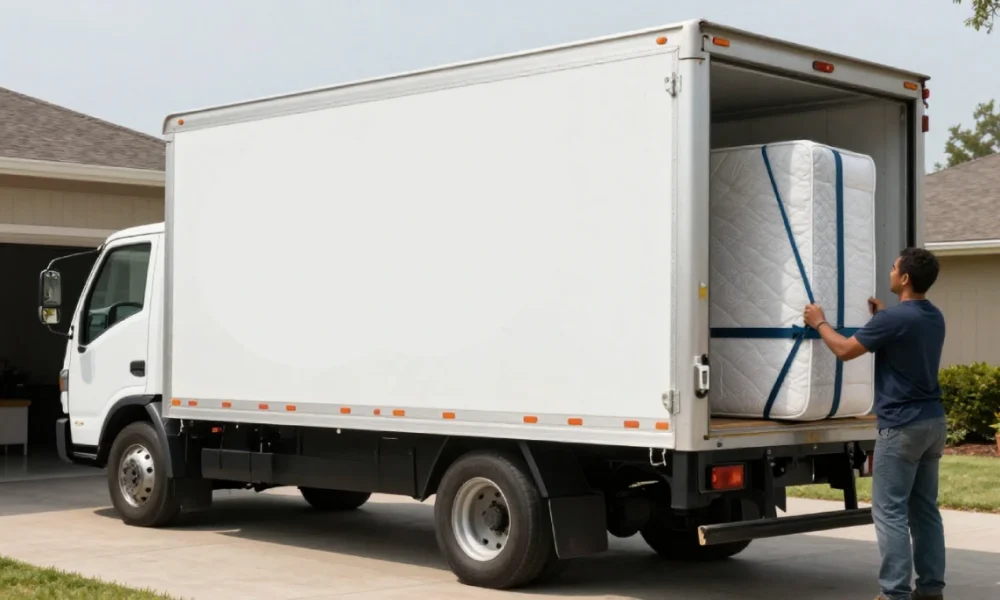
Weight distribution requires placing heaviest items on the floor toward the front near the cab. This keeps the center of gravity forward, improving stability and braking performance. Never overload the rear, as this lifts weight off the front axle and reduces steering control.
Securing cargo demands using proper tie-down straps rated for the load weight, attached to dedicated anchor points inside the truck. Prevent shifting by filling gaps with softer items or padding. Cargo movement during stops or turns causes damage and affects vehicle handling.
Loading sequence should place large, heavy items first, then fill spaces with smaller boxes. Keep frequently needed items accessible near the door. Distribute weight evenly across the floor rather than concentrating it in one area.
Height restrictions affect routes and clearances. Most rental trucks measure 11-13 feet tall, too high for many parking structures, drive-throughs, and low bridges. Plan routes accordingly and check clearances at each obstacle.
Driving considerations include:
- Allow extra braking distance—loaded trucks require 20-40% more stopping room than passenger vehicles
- Take turns slowly to prevent cargo shifting and rollovers
- Check mirrors frequently; large trucks have significant blind spots
- Avoid sudden lane changes or aggressive maneuvers
- Reduce speed on highways; rental trucks handle differently than cars
- Account for increased width when changing lanes or parking
Pre-departure checks include testing brakes before entering traffic, verifying the rear door is properly latched and locked, confirming side mirrors are properly adjusted, and ensuring all cargo is secured. Stop after 15-20 minutes of driving to recheck cargo and make adjustments if needed.
Selecting the Right Company
Rental company reputation and service quality affect the entire experience.
Major national chains including U-Haul, Penske, Budget, and Enterprise maintain extensive networks with standardized vehicles and policies. They offer advantages in availability, one-way options, and consistent service standards but may charge premium rates.
Local and regional providers sometimes offer competitive pricing and personalized service but may have limited fleet sizes and locations. They work well for local moves where one-way capability isn’t needed.
Comparison factors when evaluating companies:
- Fleet age and condition: Newer trucks experience fewer mechanical failures and include modern safety features
- Availability: Confirm the exact truck size you need is available on your preferred dates
- Location convenience: Consider pickup and drop-off location proximity to your loading and destination points
- Included services: Some companies include furniture pads, dollies, or other equipment at no additional cost
- 24/7 roadside assistance: Essential for long-distance moves or remote locations
- Customer reviews: Check recent reviews focusing on customer service, vehicle condition, and hidden fees
- Cancellation policies: Understand penalties if plans change
Request quotes from multiple providers including all fees and projected mileage charges. Ask about current promotions or corporate discounts that might apply. Verify insurance coverage details and what’s included versus optional.
Book early during peak seasons (May-September, month-end dates) as truck availability tightens significantly. Some popular sizes sell out weeks in advance during high-demand periods.
Final Considerations
Successful truck rental requires careful planning across multiple factors. Begin by accurately calculating your capacity needs using both weight and volume measurements. Select a truck type appropriate for your specific hauling application rather than simply choosing the largest or cheapest option.
Review rental agreements completely, understanding all terms, fees, and restrictions before signing. Secure adequate insurance coverage through rental company options or verify existing policy protection applies. Budget comprehensively including mileage, fuel, insurance, equipment, and potential additional charges.
Conduct thorough pre-rental inspections and document existing damage to avoid liability. Load and secure cargo properly using weight distribution best practices and adequate restraints. Operate the vehicle safely, accounting for its size, weight, and handling characteristics.
By addressing these factors methodically, you can select appropriate equipment, manage costs effectively, and complete your transport requirements safely and efficiently.