

Best Toys for 6-Year-Old Boys: Age-Appropriate Gift Ideas for 2026
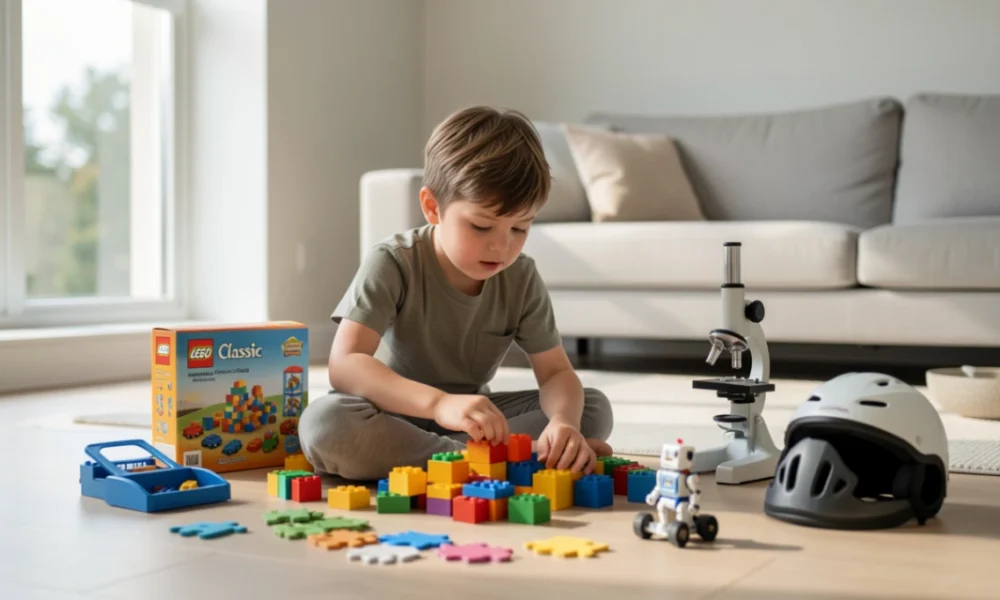
Selecting toys for 6-year-old boys requires understanding their developmental stage. At this age, children transition from kindergarten to first grade, developing stronger social skills, improved motor coordination, and growing independence. Research shows that play remains the primary way children learn, building cognitive abilities and emotional intelligence.
Table Of Content
- Understanding 6-Year-Old Development
- Key Considerations When Choosing Toys
- Best Toy Categories for 6-Year-Old Boys
- Building and Construction Toys
- STEM and Coding Toys
- Creative and Artistic Play
- Active and Outdoor Play
- Board Games and Puzzles
- Pretend Play and Role-Playing
- Electronic and Tech Toys
- Science and Exploration
- Sensory and Fidget Toys
- Popular Toy Recommendations by Category
- Building and Engineering
- STEM and Coding
- Creative Arts
- Active Outdoor Play
- Games and Puzzles
- Science and Exploration
- Tech and Electronics
- Shopping Tips for Different Occasions
- Budget Considerations
- Making the Final Decision
- Conclusion
This guide will help you choose toys that match these developmental milestones while keeping playtime engaging and fun.
Understanding 6-Year-Old Development
Six-year-olds experience significant growth. They typically gain 7 pounds and grow 2.5 inches during this year. Their gross motor skills allow them to run, jump, skip, and catch balls with confidence. Fine motor skills improve enough to write their names, draw detailed pictures, and handle smaller toy parts safely.
Cognitively, they understand concepts like counting to ten, telling time, and recognizing right from left. Socially, they begin forming stronger friendships, often preferring playmates of the same gender, and start understanding rules and fairness.
Key Considerations When Choosing Toys
Check for age labels and safety certifications. While 6-year-olds can handle more complex toys than preschoolers, avoid items with batteries that could be swallowed or parts that present hazards.
Select toys that match where your child is developmentally, while offering room to grow. Toys should challenge without frustrating.
Pay attention to what captures their attention. Some children gravitate toward building and engineering, while others prefer sports, science, or creative arts.
Best Toy Categories for 6-Year-Old Boys
Building and Construction Toys
Building sets strengthen spatial reasoning and problem-solving skills. LEGO Classic sets remain popular for their versatility and open-ended play possibilities. Magna-Tiles allow children to create three-dimensional structures, developing an understanding of geometry. K’NEX sets introduce basic engineering concepts through hands-on construction.
These toys support fine motor skill development while allowing children to see tangible results from their work.
STEM and Coding Toys
Science, technology, engineering, and math toys have become essential for this age group. Coding robots like Botley and Ozobot introduce computational thinking through screen-free play, making them ideal for beginners. National Geographic science kits let children conduct safe experiments at home, satisfying their natural curiosity.
Microscope sets allow young explorers to examine the world around them in detail. Fossil excavation kits combine hands-on digging with lessons about paleontology and history.
For children ready for screen-based learning, the Osmo Coding Starter Kit uses physical blocks with an iPad to teach programming basics. These toys build critical thinking and sequential logic skills that benefit academic performance.
Creative and Artistic Play
Art supplies remain important for self-expression. Crayola and Melissa & Doug offer quality art sets appropriate for this age. Craft kits that include multiple projects keep children engaged over time.
Play-Doh, modeling clay, and sculpting materials develop hand strength while allowing creative freedom. These activities improve fine motor control needed for writing and other school tasks.
Active and Outdoor Play
Physical activity supports healthy development. Bicycles designed for 6-year-olds, like the Schwinn Roadster 12-inch bike, help children build confidence and coordination. Scooters, including electric options like the Segway Ninebot eKickScooter, provide active outdoor fun.
Stomp Rockets fly up to 200 feet in the air and require no batteries—children simply stomp to launch. This toy combines physics learning with physical activity.
Sports equipment like junior-sized footballs, soccer balls, and basketball hoops encourages active play and can introduce organized sports. Nerf blasters and dart boards with sticky balls develop hand-eye coordination through target practice.
Board Games and Puzzles
Games teach valuable social skills. Monopoly Junior introduces money concepts and strategy. Cooperative games teach teamwork, while competitive games help children learn to win and lose gracefully.
Puzzles appropriate for this age typically have 100-300 pieces. The Rubik’s Cube and Perplexus 3D maze games challenge spatial reasoning and persistence.
Pretend Play and Role-Playing
Action figures, play kitchens, and toy sets allow children to act out scenarios they observe in daily life. Playmobil sets offer themed play environments from farms to police stations.
Dress-up costumes and props support imaginative storytelling, an important component of language development.
Electronic and Tech Toys
Walkie-talkies rated for 1,000-foot range make outdoor adventures more exciting and teach basic communication technology. Remote-controlled vehicles, particularly monster trucks with oversized tires and working lights, remain perennial favorites.
Electronic learning tablets designed for children can supplement education when used with appropriate time limits and parental controls.
Science and Exploration
Bug catchers and nature exploration kits satisfy the natural curiosity of this age group. Gardening kits teach responsibility and biology basics. Beaker Creatures science kits turn experiments into treasure hunts, making learning feel like play.
Telescope and astronomy kits introduce space science, while crystal-growing experiments demonstrate chemistry concepts safely.
Sensory and Fidget Toys
Fidget toys have gained popularity for good reason. Clickeez keyboard toys, Pop Its, and magnetic puzzle cubes provide tactile stimulation that can help with focus and stress relief. These toys work well for car rides, waiting rooms, or quiet time.
Popular Toy Recommendations by Category
Building and Engineering
- LEGO Classic Medium Creative Brick Box
- Magna-Tiles Clear Colors 100-Piece Set
- K’NEX Thrills Roller Coaster Building Set
STEM and Coding
- Botley the Coding Robot
- Ozobot Bit Coding Robot
- National Geographic Earth Science Kit
- Learning Resources Microscope Set
Creative Arts
- Crayola Ultimate Art Case
- Melissa & Doug Deluxe Standing Art Easel
- Play-Doh Modeling Compound
Active Outdoor Play
- Stomp Rocket Original
- Razor Power Core E90 Electric Scooter
- Nerf Elite 2.0 Commander Blaster
- Schwinn Koen Boy’s Bike
Games and Puzzles
- Monopoly Junior Board Game
- Perplexus Epic 3D Maze
- Ravensburger 150-Piece Puzzles
Science and Exploration
- Educational Insights GeoSafari Jr. Talking Microscope
- Dan&Darci Mega Fossil Dig Kit
- Thames & Kosmos Chemistry Experiment Kit
Tech and Electronics
- Retevis Kids Walkie Talkies
- Hot Wheels RC Monster Trucks
- LeapFrog LeapPad Academy Tablet
Shopping Tips for Different Occasions
For birthdays, consider the child’s specific interests. Ask parents about current obsessions or collections the child is building. Gifts around $25-50 typically work well, though adjust based on your relationship and budget.
Christmas and holiday shopping often involve larger or more expensive items. This is when families might invest in bikes, electric scooters, or comprehensive STEM kits. Coordinate with parents to avoid duplicates.
Celebrate the milestone with toys that acknowledge their growth. Books, educational games, or items for their room work well. “Who Would Win?” book series remains popular with this age group, combining facts with entertaining matchups.
Smaller toys under $20 make great spontaneous gifts. Craft kits, puzzles, action figures, or books show you’re thinking of them without requiring a special occasion.
Budget Considerations
Quality toys exist at every price point:
Under $20: Craft supplies, books, small action figures, fidget toys, card games $20-50: Board games, building sets, sports equipment, science kits $50-100: Bicycles, coding robots, comprehensive LEGO sets, electric scooters $100+: Advanced robotics kits, high-end ride-on toys, premium outdoor playsets
Remember that more expensive doesn’t always mean better. Many affordable toys provide hours of engaged play and learning.
While some educational technology benefits children, balance digital and physical play. The American Academy of Pediatrics recommends consistent limits on screen time for school-age children. Prioritize toys that encourage hands-on activity, social interaction, and physical movement.
Many coding toys now offer screen-free options, teaching programming concepts through physical manipulation rather than tablets or computers.
Six-year-olds can help maintain toy organization with proper systems. Clear bins labeled with pictures and words make cleanup easier. Rotate toys periodically to keep play fresh without constantly buying new items.
Making the Final Decision
When choosing toys for 6-year-old boys:
- Consider developmental appropriateness over marketing claims
- Select toys that grow with the child
- Prioritize quality over quantity
- Balance different play types (active, creative, educational, social)
- Involve the child in selection when appropriate
- Read reviews from other parents
- Check return policies before purchasing
Conclusion
The best toys for 6-year-old boys combine fun with developmental benefits. Whether you choose building sets that teach engineering concepts, science kits that spark curiosity, or active toys that build physical skills, focus on what matches the individual child’s interests and developmental stage.
At six years old, children stand at an exciting developmental crossroads. They’re capable enough for complex projects yet still young enough to fully embrace imaginative play. The right toys support their growth while creating memories that last well beyond childhood.