

Understanding Quantum Computing Research Through Young Researchers Like Augie Martinez
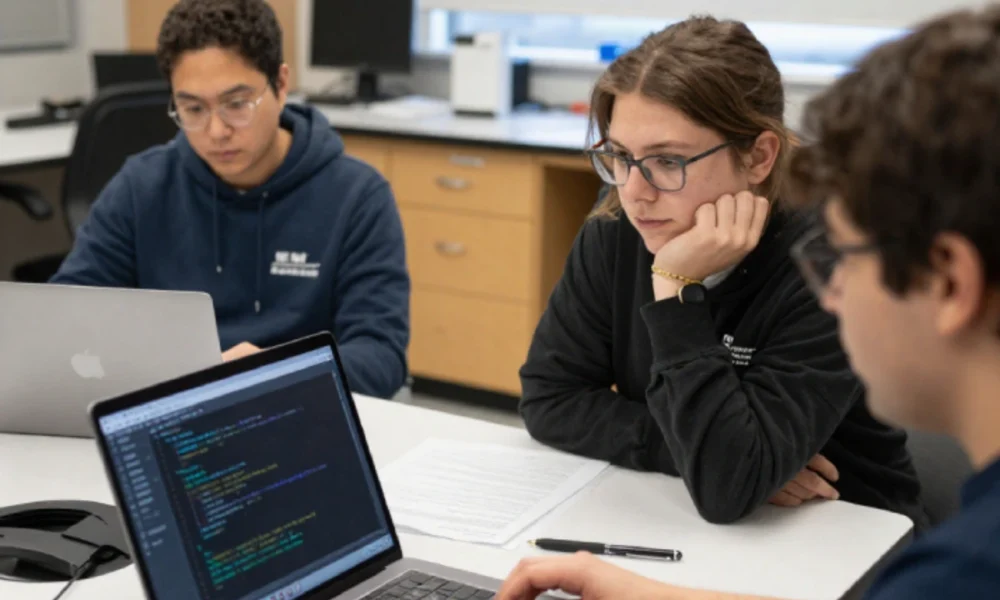
Quantum computing represents one of the most promising frontiers in modern technology. Young researchers like Augie Martinez at Lehigh University demonstrate how the next generation is approaching the complex challenges that stand between current quantum systems and practical applications.
Table Of Content
- The Path Into Quantum Research
- Quantum Error Correction: A Central Challenge
- From Student to Researcher
- Making Complex Concepts Accessible
- Real-World Applications of Quantum Research
- Challenges Facing Quantum Researchers
- Quantum Networks and Future Directions
- Building Quantum Communities
- Recognition and Impact
- The Quantum Advantage Threshold
- Balancing Research and Education
- Quantum Technology’s Broader Impact
- Conclusion
Martinez’s work focuses on quantum error correction and algorithm development, areas that remain central to making quantum computers viable for real-world use. His path into quantum research illustrates how curiosity and persistence shape careers in this demanding field.
The Path Into Quantum Research
Many quantum researchers don’t start with quantum mechanics as their first interest. Martinez’s background in engineering provided a foundation before quantum physics captured his attention during undergraduate studies. This pattern—entering quantum computing from adjacent fields like engineering, computer science, or mathematics—is common among researchers.
Early exposure to quantum mechanics concepts often proves decisive. The counterintuitive nature of quantum phenomena, where particles exist in multiple states simultaneously and distant particles remain mysteriously connected, draws people who enjoy intellectual challenges.
Strong mentorship matters significantly in quantum research. Advisors who recognize unconventional thinking and encourage questions help students build confidence in a field where traditional intuition often fails.
Quantum Error Correction: A Central Challenge
Quantum computers operate fundamentally differently from classical computers. Where traditional computers use bits representing either 0 or 1, quantum computers use qubits that can exist in superposition—effectively being 0 and 1 simultaneously until measured.
This quantum behavior creates enormous computational potential. Problems requiring classical computers to check millions of possibilities sequentially might be solved simultaneously by quantum systems. However, qubits are extraordinarily fragile. Environmental interference—even tiny temperature fluctuations or stray electromagnetic fields—causes errors that corrupt calculations.
Quantum error correction addresses this vulnerability. Researchers develop methods to detect and fix errors without destroying the delicate quantum states. This work combines physics, mathematics, and computer science.
Martinez’s research explores topology-inspired approaches to error correction. Topological methods use the mathematical properties of shapes and spaces to create more stable quantum states. When successful, these techniques reduce error rates and bring quantum computers closer to practical reliability.
From Student to Researcher
The transition from student to active researcher involves challenges beyond understanding complex mathematics and physics. Graduate-level quantum theory requires comfort with abstract concepts that have no everyday analogies.
Many researchers experience periods of frustration when confronting difficult papers or stalled experiments. Persistence through these obstacles separates those who continue in research from those who pursue other paths. Breaking complex problems into smaller, manageable pieces helps researchers maintain progress during difficult stretches.
Publishing research represents another significant milestone. Academic papers undergo rigorous peer review, where other experts examine methods, logic, and conclusions. Early publications build credibility and open doors to collaboration and funding.
Research awards recognize both the quality of work and its potential impact. Such recognition helps early-career researchers secure additional funding and establish their reputation within the scientific community.
Making Complex Concepts Accessible
Quantum mechanics is notorious for being difficult to explain. The mathematics is sophisticated, and the phenomena defy everyday experience. Researchers who can explain quantum concepts clearly serve an important role beyond their technical contributions.
Educational content—whether through teaching, videos, articles, or public presentations—helps grow the field by making it less intimidating. When researchers explain quantum entanglement using everyday analogies or break down complex notation into understandable steps, they lower barriers for newcomers.
This communication skill proves valuable when presenting work to funding agencies, industry partners, or policymakers who control research resources but may lack technical backgrounds. The ability to connect abstract quantum concepts to practical applications helps secure support for continued research.
Real-World Applications of Quantum Research
Quantum computing’s potential extends far beyond academic laboratories. Several fields could see transformation as quantum computers become more capable and reliable.
Drug Discovery and Medicine: Quantum computers could model complex molecular interactions more accurately than classical computers. Simulating how protein molecules fold or how potential drugs interact with target molecules requires enormous computational power. More accurate simulations could accelerate the development of new medications.
Financial Modeling: Financial markets involve countless variables and complex interactions. Quantum computers might analyze these systems more comprehensively, improving risk assessment and investment strategies.
Climate Science: Understanding and predicting climate change requires modeling vast, interconnected systems. Quantum computing could enhance climate models, leading to better predictions and more effective response strategies.
Cryptography and Security: Quantum computers pose both threats and opportunities for data security. They could break many current encryption methods, but quantum principles also enable new forms of secure communication that are theoretically impossible to intercept undetected.
When research advances translate into practical tools, the impact extends well beyond the laboratory. Companies and institutions implementing new quantum techniques represent the bridge between theoretical research and real-world benefit.
Challenges Facing Quantum Researchers
Quantum research demands patience. Progress often comes in small increments rather than dramatic breakthroughs. Experiments may fail repeatedly before yielding useful results. Quantum systems behave unpredictably, requiring researchers to develop both technical expertise and mental resilience.
Funding remains competitive. While interest in quantum technology has grown, many researchers compete for limited grant resources. Success requires not only strong research proposals but also the ability to communicate why the work matters to evaluators who may not be quantum specialists.
The interdisciplinary nature of quantum computing creates both opportunities and challenges. Researchers must understand physics, mathematics, computer science, and engineering. This breadth enriches the work but also demands continuous learning across multiple domains.
Quantum Networks and Future Directions
Beyond improving individual quantum computers, researchers are exploring quantum networks—systems allowing quantum computers to connect and share quantum information. These networks could enable secure communication channels based on quantum entanglement.
When two particles become entangled, measuring one instantly affects the other, regardless of distance. This property could create communication systems where any attempt to intercept information would be immediately detectable. Applications in banking, healthcare, and national security could benefit from such guaranteed security.
Developing practical quantum networks requires solving numerous technical challenges. Quantum states must be maintained while photons travel through fiber optic cables or free space. Distance limits must be overcome. Error correction becomes even more complex when quantum information moves between systems.
Research in this area combines experimental work with theoretical development. Lab demonstrations prove concepts work under controlled conditions. Engineering refinements move proven concepts toward practical implementation.
Building Quantum Communities
Growing the quantum computing field requires more than individual research achievements. Building communities where students and researchers collaborate, share knowledge, and support each other’s development strengthens the entire field.
University quantum computing clubs provide spaces where students from different backgrounds—physics, mathematics, computer science, engineering—can explore quantum concepts together. Hackathons and collaborative projects give students hands-on experience with quantum programming platforms and real-world problem-solving.
These activities serve multiple purposes. Students gain practical skills. They build networks with peers who share their interests. They discover whether quantum computing matches their career interests before committing to graduate study.
Mentorship within these communities matters greatly. When experienced researchers make time to guide students, answer questions patiently, and provide encouragement, they help newcomers overcome the intimidation factor that quantum computing can present.
Recognition and Impact
Recognition in science serves several functions. Awards and honors acknowledge significant contributions and provide motivation. They also raise visibility for important work, potentially attracting collaborators, students, and funding.
Lists recognizing young innovators highlight emerging talent and can accelerate careers by increasing professional visibility. Such recognition, while validating, represents a milestone rather than a destination.
Participation in industry consortiums and working groups allows researchers to influence how quantum technology develops beyond academia. These roles shape workforce development strategies, technical standards, and policy recommendations that affect the field’s growth.
The Quantum Advantage Threshold
The quantum computing field works toward “quantum advantage”—the point where quantum computers solve practically important problems faster or more accurately than any classical computer could in reasonable timeframes.
Some quantum advantage demonstrations have already occurred for specialized problems. The challenge lies in achieving quantum advantage for problems that matter in medicine, finance, materials science, cryptography, and other high-impact domains.
Multiple obstacles must be overcome. Error rates must decrease further. Qubit counts must increase. Quantum algorithms must improve. Supporting infrastructure—from cooling systems to control electronics—must advance.
Progress continues across all these fronts. Each improvement brings practical quantum computing closer to reality.
Balancing Research and Education
Universities provide environments where research and teaching intersect productively. Researchers pursuing cutting-edge investigations simultaneously train the next generation of scientists and engineers.
This balance offers benefits beyond the obvious knowledge transfer. Teaching reinforces understanding—explaining concepts to others reveals gaps in one’s own knowledge. Student questions sometimes spark new research directions. Mentoring relationships often outlast specific projects, creating lasting professional networks.
The combination of advancing knowledge through research while sharing that knowledge through teaching creates a sustainable model for scientific progress. Individual discoveries matter, but the broader impact comes from building a growing community of capable researchers.
Quantum Technology’s Broader Impact
Quantum technology won’t remain confined to specialized laboratories. As quantum computers become more powerful and accessible, their influence will spread across society.
Online security protocols will need updating as quantum computers gain the ability to break current encryption methods. New quantum-resistant cryptography will protect digital information.
Materials science could be transformed by the ability to simulate atomic and molecular behavior with unprecedented accuracy. This might accelerate the discovery of new materials for batteries, solar cells, medical devices, and countless other applications.
Artificial intelligence and machine learning might benefit from quantum approaches to certain types of pattern recognition and optimization problems.
The timeline for these transformations remains uncertain. Some applications may arrive within years; others may require decades. The foundational work happening now in laboratories determines how quickly and effectively quantum technology delivers on its potential.
Conclusion
Researchers like Augie Martinez at Lehigh University represent the generation building quantum computing’s future. Their work on error correction, quantum networks, and algorithm development addresses the technical challenges preventing quantum computers from reaching their full potential.
Beyond technical contributions, their efforts to explain quantum concepts clearly and build supportive research communities help ensure the field continues growing. As quantum technology advances from laboratory demonstrations toward practical applications, the combination of rigorous research and effective knowledge sharing will determine how quickly society benefits from quantum computing’s promise.
The quantum revolution remains in its early stages. The work being done today lays groundwork for transformations that may reshape computing, security, medicine, and scientific discovery in the coming decades.