

What is CNC Machining? A 2026 Guide to Components, Process, and Industry Applications
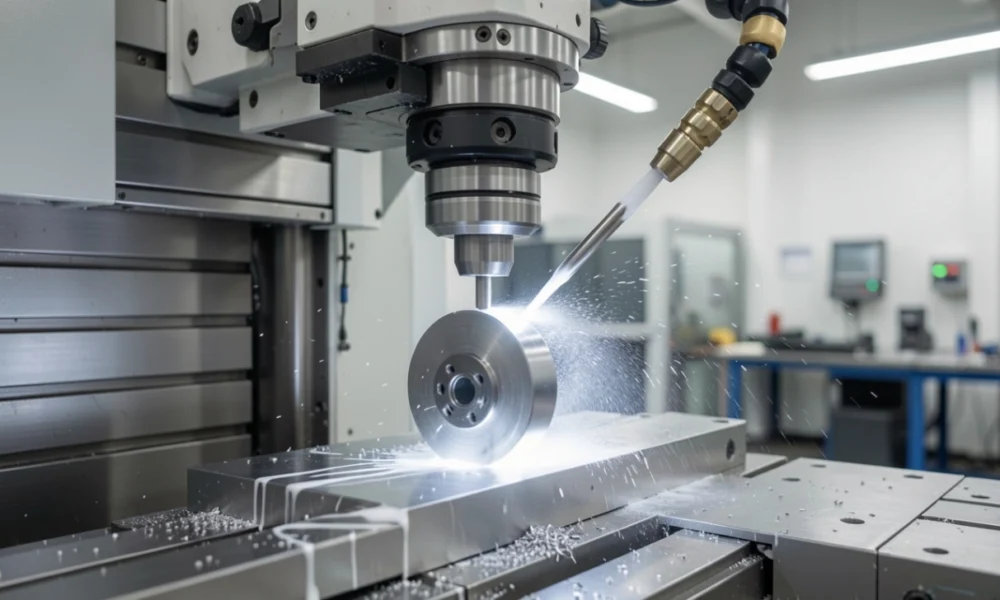
CNC (Computer Numerical Control) machining is a foundational manufacturing process that uses pre-programmed computer software to control the movement of tools and machinery. This advanced technology enables the creation of complex parts and components with high accuracy and repeatability.
Table Of Content
As a form of subtractive manufacturing, the process creates the desired shape by removing material from a solid block (the workpiece) through cutting, milling, turning, or drilling. Unlike manual machining, where operators directly control the tools, CNC machining automates the process, enhancing precision and reducing the likelihood of human error. The global CNC machines market is estimated at USD 79.14 billion in 2026, driven by demand for digitally enabled production and tighter tolerances in key sectors like automotive and aerospace.
This guide explores the core components of a CNC machine, its operational process, the common types of machines, and the primary industries that rely on this technology.
Key Components of a CNC Machine
A CNC machine is a complex system where hardware and software work in unison. Understanding its core components provides a clear picture of how precision is achieved.
- Input Devices: This is the interface for feeding the part program into the machine. Common input devices include a computer interface for direct transfer from Computer-Aided Manufacturing (CAM) software, or i, in older systems, a punch tape reader.
- Machine Control Unit (MCU): The MCU is the brain of the CNC machine. It reads the coded instructions (G-code), decodes them, and sends precise movement commands to the driving system. The MCU also controls auxiliary functions like coolant flow, spindle speed, and automatic tool changes.
- Driving System: This system receives the low-voltage signals from the MCU and amplifies them to actuate the machine’s moving parts. It includes amplifier circuits, drive motors (servo or stepper), and ball lead screws that convert rotational motion into precise linear movement.
- Machine Tool: This is the physical structure of the machine that performs the work. It typically consists of a worktable, a spindle that holds and rotates the cutting tool, and the axes of motion (e.g., sla iding table for X and Y axes, a spindle for the Z axis).
- Feedback System: Crucial for closed-loop control, this system monitors the actual position and speed of the machine tool at all times. Using sensors and transducers, it sends real-time data back to the MCU. If the actual position deviates from the commanded position, the MCU makes instant corrections to ensure high precision.
- Display Unit: The display unit provides operators with a real-time interface to monitor the program, machine status, tool position, and any diagnostic alerts.
How CNC Machine Works: A 6-Step Process
The operation of a CNC machine follows a systematic, automated sequence.
- Design and Programming: The process begins with a 3D CAD model of the part. This model is imported into CAM software, which generates the toolpaths and converts the design into a set of machine-readable instructions, typically G-code.
- Program Entry: The completed part program is transferred from the CAM software to the machine’s MCU via a computer network or other input device.
- Data Processing and Command: The MCU processes the program data, calculates the exact motion paths, and sends a stream of electrical signals (motion commands) to the driving system.
- Machine Tool Activation: The driving system amplifies these commands to activate the servo motors, which precisely move the machine table and spindle along the programmed axes. The spindle rotates the cutting tool to the required speed to begin material removal.
- Simultaneous Feedback Monitoring: As the machine operates, the feedback system continuously monitors the position and velocity of the moving parts. This data is instantly sent back to the MCU.
- Real-Time Error Correction: The MCU compares the feedback signals with the original motion commands. If a discrepancy is found, it instantly generates new control signals to correct the error, ensuring the machining stays within the specified tolerance. Operators can monitor this entire process on the display unit.
Common Types of CNC Machines
CNC technology is applied to a wide variety of machine tools, each suited for specific geometries and operations. CNC lathes, for instance, captured a significant portion of the market in 2025 due to their essential role in producing cylindrical parts.
- CNC Milling Machines: Perhaps the most common type, these machines use rotary cutters to remove material from a workpiece. They can be configured with 3, 4, or 5 axes. 5-axis machining is becoming more common for production work as it allows for the creation of complex parts in a single setup, improving precision and reducing lead times
- CNC Lathes: In these machines, the workpiece rotates against a stationary cutting tool. They are ideal for creating symmetrical parts like shafts, bushings, and bowls.
- CNC Laser Cutting Machines: This segment is growing rapidly due to the precision and speed of fiber laser technology, which can cut through steel and aluminum with minimal distortion.
- CNC Routers: Similar to milling machines, they are typically used for cutting softer materials like wood, plastics, and composites.
- CNC Electrical Discharge Machines (EDM): This process uses electrical sparks to erode material from a conductive workpiece, making it ideal for creating very hard metals or intricate shapes and deep cavities that are difficult to produce with traditional cutting tools.
- CNC Grinding Machines: These machines use a rotating abrasive wheel to achieve a very high surface finish and tight tolerance on a workpiece.
Primary Industries and Applications
The precision, repeatability, and efficiency of CNC machining make it indispensable across numerous industries. The table below outlines some of the primary sectors that rely on this technology.
| Industry | Common Applications | Key Requirements |
|---|---|---|
| Aerospace & Defense | Turbine blades, structural components, landing gear parts, engine casings | High precision, complex geometries, traceability, exotic materials (titanium, Inconel) |
| Automotive | Engine blocks, transmission housings, EV battery housings, inverter plates, custom parts | High-volume production, repeatability, and tight tolerances |
| Medical Devices | Surgical instruments, orthopedic implants (knees, hips), prosthetics, and custom dental components | Biocompatible materials, surface finish, micron-level accuracy, single-part customization |
| Electronics & Semiconductor | Enclosures, heat sinks, connectors, and precision components for chip manufacturing equipment | Miniaturization, high detail, clean room compatibility |
| General Manufacturing | Custom tooling, machine parts, industrial components, prototypes | Versatility, speed, and cost-effectiveness |
2026 Trends and the Future of CNC Machining
The CNC machining landscape is evolving rapidly, with several key trends shaping the industry in 2026. These developments are moving the industry from standalone machining to integrated, intelligent production.
- AI-Native Machining: Artificial intelligence is moving from experimental monitoring to integral machine control. AI systems now use real-time sensor feedback to automatically adjust feeds, speeds, and toolpaths in response to vibration or temperature changes, leading to more consistent quality and lower tool wear.
- Automation and Lights-Out Manufacturing: To address labor shortages and increase throughput, shops are increasingly investing in automation. This includes robot-tended CNC cells, automated pallet changers, and even automating support processes like part washing and inspection. The goal is “lights-out manufacturing,” where machines run unattended for extended periods.
- Digital Twins as Standard: Digital twins are becoming a production backbone. These are dynamic, virtual models of the machining process that integrate design, engineering, and machining. They allow for virtual commissioning and clash detection before any physical cutting begins, significantly reducing setup errors and lead times.
- Hybrid Manufacturing: The line between additive and subtractive processes is blurring. Hybrid machines combine metal deposition (3D printing) with CNC cutting on a single platform. This allows for repairing high-value parts, creating internal features impossible to machine, and reducing material waste.
- Sustainability as a Core Metric: Environmental performance is becoming a key operational metric. Shops are adopting Minimum Quantity Lubrication, dry cutting, and advanced coolant recycling systems to reduce waste and energy consumption.
Conclusion
CNC machining remains a critical pillar of modern manufacturing, offering unmatched precision, versatility, and efficiency. By automating the production process and minimizing human error, CNC machines ensure high-quality output, making them indispensable in industries that demand high precision. As we move through 2026, the integration of AI, automation, and smart technologies is transforming the machine shop, making it more connected, efficient, and capable than ever before. Understanding the core components and process provides the foundation for appreciating its critical and evolving role in advancing manufacturing technology.