

The Definitive Guide to Ultra Short Throw Projectors: Technology, Benefits, and Buying Tips for 2026
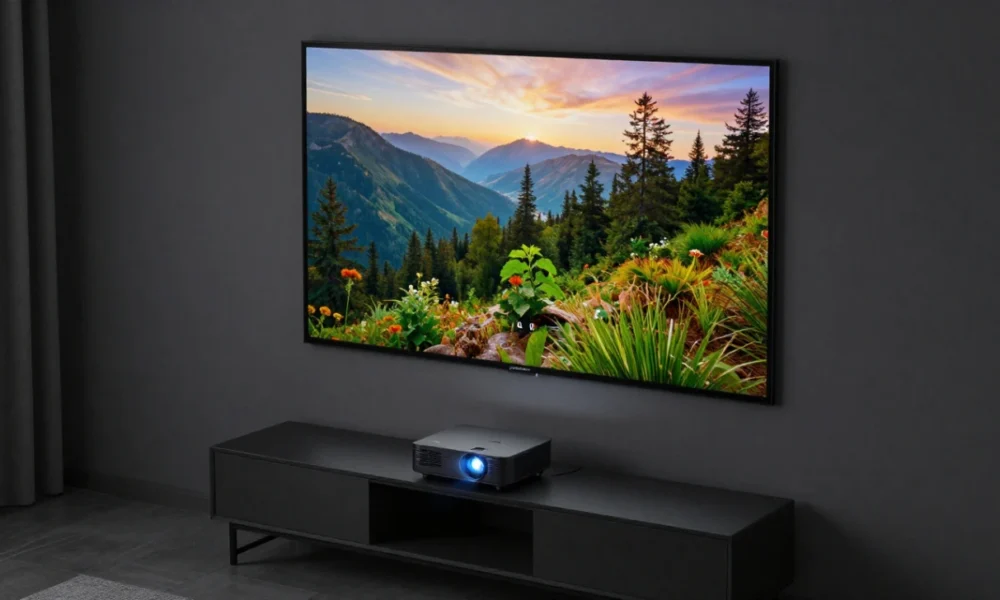
Visual communication has gained popularity over the years as it assists in conveying information more conveniently, enhancing audience engagement across various settings. A significant driver of this trend is the evolution of display technology, particularly the rise of ultra-short-throw projectors. These innovative devices are redefining what’s possible in both home theaters and professional environments by delivering giant, high-quality images without requiring a large room.
Table Of Content
- Understanding Ultra Short-Throw Projectors
- Key Technologies and Features in Modern UST Projectors
- Light Source Technologies
- Image Processing and Setup
- Unmatched Benefits of UltraShort-Throwjectors
- Primary Uses and Applications of Ultra Short-Throw Projectors
- Optimizing Your Setup: Screens and Placement
- The Importance of Ambient Light Rejecting (ALR) Screens
- Placement Considerations
- The Future of Display Technology
- Bottom Line
This guide provides a comprehensive look at ultra-short-throw projectors, exploring their inner workings, key advantages, diverse applications, and what to consider when integrating one into your space.
Understanding Ultra Short-Throw Projectors
Ultra short-throw (UST) projectors are display devices engineered to cast a very large image from an extremely close distance to the screen or wall. Unlike traditional projectors that often need to be placed several feet away—sometimes in the middle of a room—a UST projector sits directly below or against the projection surface. Their sophisticated internal mechanism relies on advanced optics. A light source, typically a laser or LED, directs a beam through a series of specialized mirrors and ultra-wide-angle lenses, which then “paints” the image onto the screen from a short distance
The defining characteristic of a UST projector is its throw ratio. This is the ratio of the distance from the projector to the screen, divided by the width of the image. While a standard projector might have a throw ratio of 1.0 to 1.5, an ultra-short-throw projector boasts a ratio of less than 0.4, meaning it can create a 100-inch image from less than 18 inches away.
Key Technologies and Features in Modern UST Projectors
To fully appreciate the capabilities of an ultra-short-throw projector, it’s important to understand the core technologies that power them.
Light Source Technologies
The light source is the heart of a projector, dictating its brightness, color, and lifespan. Modern UST projectors primarily use three types :
- Laser Projectors: These use lasers to produce light and are known for their high brightness (often 2,000+ lumens), exceptional color accuracy, wide color gamut, and long lifespan (20,000+ hours). They are ideal for rooms with ambient light.
- LED Projectors: Utilizing LEDs, these projectors are energy-efficient, have an even longer lifespan (up to 30,000 hours), and are often more compact and portable. They typically have lower brightness than lasers, making them best suited for darker environments
- Hybrid (Laser/LED) Projectors: A newer category combining both technologies to balance brightness, color volume, and longevity, aiming to deliver superior image quality by mitigating the limitations of single-light sources .
Image Processing and Setup
Modern UST projectors come equipped with intelligent features that simplify setup and enhance the viewing experience. Advanced digital keystone correction and auto-focus can automatically adjust the image to ensure it is perfectly square and sharp, even if the projector isn’t placed on a perfectly level surface . Many models now run on smart platforms like Google TV, offering built-in streaming apps, voice control, and wireless casting, which eliminates the need for external streaming devices .
Unmatched Benefits of UltraShort-Throwjectors
The revolutionizing power of UST projectors lies in the unique benefits they offer compared to both traditional projectors and large-format televisions.
- Space-Saving Design: The primary advantage is the ability to place the projector just inches from the wall. This eliminates the need for ceiling mounts, long cable runs, and the worry of people walking through the beam and casting shadows on the screen.
- Superior Image Quality: With the advent of 4K resolution and high dynamic range (HDR), UST projectors deliver stunningly sharp, vibrant, and detailed images that can rival many TVs, especially at larger screen sizes of 100 inches or more
- Reduced Glare and Shadows: Because the projector is so close to the screen and light is projected upward at a steep angle, it significantly reduces the glare and eye strain that can sometimes occur with standard projectors. It also ensures that presenters or gamers can move in front of the unit without blocking the image .
- Portability and Flexibility: The market now includes portable UST projectors with built-in batteries, allowing you to transform any space—from a backyard to a camping trip—into a cinematic experience. The compact size also makes them easy to store when not in use.
Primary Uses and Applications of Ultra Short-Throw Projectors
The versatility of UST projectors makes them suitable for a wide range of applications far beyond the living room.
- Home Entertainment and Gaming: This is the most common use, where UST projectors act as a “Laser TV,” replacing a traditional television for watching movies, sports, and TV shows. Their low-latency and high-refresh-rate options also make them increasingly popular for an immersive gaming experience.
- Professional and Educational Environments: In conference rooms, a UST projector can turn any flat surface into a collaborative display without the glare of a standard projector. In classrooms, they can be used to create interactive whiteboards when paired with a touch-sensitive screen, fostering greater engagement.
- Public Events and Digital Signage: For trade shows, retail window displays, or public speaking events, UST projectors can display high-impact, large-format visuals without taking up valuable floor space or creating obstructive shadows
Optimizing Your Setup: Screens and Placement
While an ultra-short-throw projector can project onto a plain wall, achieving a true cinematic experience often requires a specialized screen.
The Importance of Ambient Light Rejecting (ALR) Screens
Standard projector screens are designed to reflect light to the viewer, but they are also good at reflecting ambient light, which washes out the image. An Ambient Light Rejecting (ALR) screen is engineered with a unique optical microstructure that specifically targets and rejects light coming from above and the sides (like ceiling lights or sunlight from a window) while selectively reflecting the light from the projector back to the viewer.
This technology results in dramatically improved contrast, deeper blacks, and more vibrant colors, making daytime viewing possible without total blackout curtains. Some high-quality ALR screens can improve image quality by up to 80% and reject up to 95% of ceiling light. These screens come in various forms, including fixed-frame and motorized floor-rising models, which offer a clean, “disappearing” aesthetic when not in use
Placement Considerations
Careful placement is still crucial for optimal performance. Ensure the projector is level and positioned at the correct height relative to the screen. Consulting the manufacturer’s throw distance chart is essential to achieve the desired image size .
The Future of Display Technology
The rapid advancements in ultra-short-throw projectors point toward an exciting future for display technology. We are already seeing trends like higher brightness, more compact designs with improved cooling, and features like automatic lens covers to protect against dust. As hybrid light sources mature and prices become more competitive, UST projectors are poised to become a mainstream alternative to large televisions, offering a scalable, immersive, and space-conscious solution for the modern world
Bottom Line
The ultra-short-throw projector represents a significant leap forward in how we experience large-format visuals. By combining cutting-edge optical design with smart features and laser-driven performance, these devices effectively dissolve the constraints of space that have long been associated with big screens. Whether for a dedicated home theater, a dynamic classroom, or a flexible living space, a UST projector offers a compelling blend of performance and practicality that is hard to match.