

Maximizing Educational Spaces: How Self-Storage Supports Teachers, Students, and Lifelong Learning
The modern educational journey—whether for a seasoned educator, a university student, or a homeschooling family—often comes with a physical footprint. Classrooms become repositories for seasonal decorations and surplus supplies, dorm rooms overflow by mid-semester, and curricula and projects can consume homes. While often associated with moving, self-storage units have evolved into versatile tools for managing these educational challenges. They offer a practical bridge between limited indoor space and the abundant materials required for effective teaching and learning.
Table Of Content
- A Strategic Solution for Classroom Management
- Document Archiving and Administrative Efficiency
- Navigating College Life with Self-Storage
- Creating an Organized Homeschool Environment
- Maximizing Your Storage Unit: Practical Tips for Organization
- Frequently Asked Questions About Educational Storage
- onclusion
This guide provides an in-depth look at how educators, students, and families can strategically use self-storage to create more organized, flexible, and focused learning environments.
A Strategic Solution for Classroom Management
For teachers, the classroom is a dynamic workspace that must constantly adapt. The start of a school year brings an influx of supplies, while the end brings a surge of student work and the need to reset for the next term. Self-storage offers a professional solution to manage this cycle effectively.
1. Storing Surplus and Seasonal Supplies
Educators often purchase or receive supplies in bulk. Instead of letting these items clutter precious shelf space, a nearby storage unit can serve as an external stockroom. This is particularly useful for:
- Rationing Supplies: Store excess notebooks, paper, and art materials, and restock throughout the year to prevent a shortage later.
- Managing Donations: Many teachers receive donations of books and materials. A storage unit allows them to accept these generous offers without overwhelming the classroom.
- Rotating Materials: Store thematic teaching aids, models, or games and rotate them in and out to keep the curriculum fresh and engaging.
2. The Importance of Climate-Controlled Storage
Many educational items are sensitive to extreme temperatures and humidity. For these, a standard unit may not suffice. Climate-controlled units maintain a consistent temperature and humidity level, typically between 55°F and 80°F. This environment is crucial for preserving:
- Textbooks and Paper Products: Fluctuating humidity can cause paper to warp, become brittle, or develop mold .
- Art Supplies: Materials like paints, adhesives, and clay can be ruined by extreme heat or cold.
- Technology: Electronic equipment, from calculators to document cameras, is vulnerable to moisture damage.
- Scientific Models: Preserved specimens or delicate models require stable conditions to remain intact.
Professional archival standards, such as those used by universities, emphasize the need for controlled environments to extend the life of materials. For instance, specialized archival storage rooms for institutions maintain temperatures between 50°F and 68°F with low relative humidity to protect items ranging from books to artwork . While home-use self-storage may not meet these exact industrial specifications, a climate-controlled unit provides a significant layer of protection for valuable educational assets.
Document Archiving and Administrative Efficiency
Educational institutions generate a significant amount of paperwork, from student records and administrative files to research data and historical documents. While digital storage is prevalent, physical copies often remain necessary for legal or archival reasons.
Self-storage units can act as an extension of an institution’s filing system. By moving less-frequently accessed but important documents off-site, schools and universities can free up valuable administrative office space. The key benefits of this approach include:
- Enhanced Security: Reputable facilities offer gated access, individual unit alarms, and 24/7 digital surveillance, protecting sensitive information from theft or unauthorized access .
- Organized Accessibility: With a good inventory system, documents stored off-site can be easily located and retrieved when needed, unlike items lost in a cluttered basement or back office.
- Cost-Effectiveness: Renting a storage unit is often far more affordable than renovating existing space to add more filing cabinets or shelving.
Navigating College Life with Self-Storage
College students face a unique set of logistical hurdles, primarily stemming from living in small, shared spaces and relocating frequently . Self-storage provides a flexible solution to these common challenges.
Managing Dorm Room Space
Dorm rooms are notoriously small. A standard double-occupancy room offers limited closet and floor space. A small, locker-sized storage unit near campus can be a game-changer. Students can use it to store:
- Off-season clothing (winter coats during spring, summer clothes during winter).
- Sports equipment like skis, surfboards, or bicycles.
- Hobby supplies (musical instruments, art easels) that aren’t used daily.
- Extra bulk items, keeping the dorm room tidy and conducive to studying .
The Summer Break Dilemma
One of the most significant challenges for students is what to do with their belongings over summer break. Most universities require students to vacate their rooms completely, as they are used for conferences, summer programs, or maintenance. Hauling everything back home can be expensive and impractical, especially for international students or those far from home.
Self-storage offers a perfect middle ground. Students can rent a unit for the summer months, store their boxes, furniture, and appliances, and retrieve them when they return in the fall. This eliminates the stress of multiple long-distance moves. Data suggests that a large majority of college students utilize storage for this exact purpose, with many reporting reduced stress during these transitions.
Easing Post-Graduation and Study Abroad Transitions
The utility of storage extends beyond summer. For students heading abroad for a semester, a storage unit provides a secure place for their belongings while they’re gone. Similarly, recent graduates moving to a new city for a job may need a temporary place to store their possessions while they secure permanent housing, avoiding the cost and commitment of a full apartment immediately .
Choosing the Right Storage Features
When selecting a unit, students should consider features that add convenience:
- 24/7 Access: College schedules are unpredictable. Being able to access a unit late at night or on weekends provides maximum flexibility .
- Month-to-Month Leases: Students rarely need year-round storage. Month-to-month rentals allow them to pay only for the time they need, such as the summer months or a single semester .
- Proximity to Campus: Choosing a facility close to campus or with easy access makes dropping off and picking up items quick and simple.
- Mobile Storage Options: Some companies offer a “pod” service, where a portable storage container is dropped off for the student to fill, then picked up and stored. This can be especially convenient for move-out days .
Creating an Organized Homeschool Environment
Homeschooling transforms parts of a home into a dedicated learning space. However, the ebb and flow of curricula can easily lead to clutter. Self-storage helps homeschooling families maintain a clear distinction between “home” and “school.”
A storage unit can serve as a resource library. Families can store books, science kits, and historical unit study materials that are used on a rotating basis. This allows for a wide variety of resources without them permanently taking over the living room shelves. Furthermore, as children grow, curricula and projects from previous years can be archived. Instead of throwing away cherished work, families can use storage to preserve a selection of portfolios, artwork, and projects, creating a lasting record of the child’s educational journey.
For families that create a lot of physical projects—such as in woodworking, art, or large-scale science fairs—a storage unit can act as a project staging area, keeping works-in-progress safe and out of the way until completion .
Maximizing Your Storage Unit: Practical Tips for Organization
Simply renting a unit is only the first step. To truly benefit, a system must be in place. Here are practical strategies to ensure your educational storage is effective :
- Purge Before You Store: Before packing, take time to discard or donate items that are truly no longer needed. Outdated worksheets, broken supplies, and old drafts only take up space.
- Categorize and Label Everything:
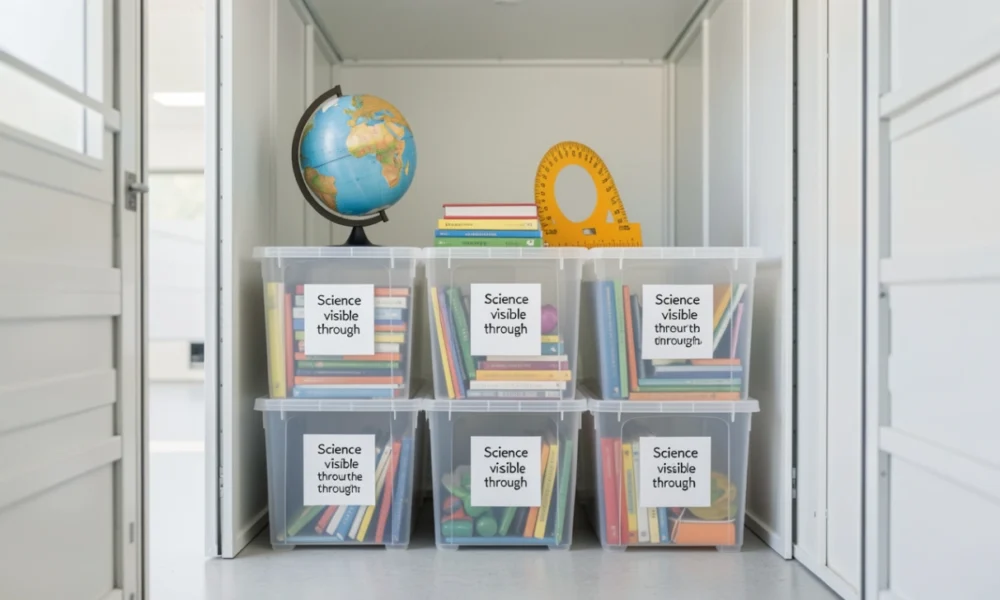
- Use clear, plastic bins. They are stackable, protect against pests and moisture better than cardboard, and allow you to see the contents at a glance.
- Create a color-coding system. For example, blue bins for math resources, red for history, and green for science.
- Label each bin clearly on all sides with a permanent marker or large printed label. Be specific (e.g., “Fall Art Supplies,” “Chemistry Textbooks,” “Winter Classroom Decor”).
- Create an Inventory List: Keep a master list (either in a notebook or a digital document) of what is in each bin and where it is located in the unit. This is invaluable when you need to find a specific item without rummaging through everything.
- Maximize Vertical Space: Stack bins securely, but place heavier boxes at the bottom. Utilize shelving units if the facility allows, which can double your usable space.
- Plan for Accessibility: Place items you might need occasionally towards the front of the unit. Items that are truly for long-term archival can be stacked towards the back.
Frequently Asked Questions About Educational Storage
What is the best way to organize classroom supplies in a storage unit? Use clear, labeled plastic bins categorized by subject, season, or type (e.g., “Math Manipulatives,” “Holiday Decor,” “Art Supplies”). Stack them on shelving units for easy access and keep an inventory list .
Is a climate-controlled unit necessary for storing books and documents? For short-term storage of general books, a standard unit may suffice. However, for long-term preservation, valuable textbooks, important documents, and any paper-based items you want to protect from yellowing, warping, or mold, a climate-controlled unit is highly recommended.
Can I share a storage unit with other teachers or students to save money? Yes, this is a common and cost-effective practice. Teachers in the same school or a group of students can split the cost of a larger unit . It’s advisable to have a clear agreement on organization, access, and shared costs.
What security features should I look for in a storage facility? Look for facilities with gated access requiring a unique PIN code, 24/7 digital video surveillance, individual door alarms on each unit, and well-lit premises . Are there alternatives to traditional self-storage for college students? Yes. Some students use “mobile storage” or “box delivery” services. These companies deliver boxes and tape, pick up the filled boxes, store them, and then deliver them back to the student’s new address at the end of the summer, offering a full-service, door-to-door solution .
onclusion
Self-storage has matured into a versatile tool that directly addresses the spatial and organizational challenges present in modern education. For teachers, it provides a vital off-site stockroom to manage classroom resources efficiently. For college students, it offers a flexible and secure solution to navigate the logistical complexities of dorm life and frequent moves. For homeschooling families, it creates space to breathe, allowing for a rich curriculum without sacrificing the comfort of the home.
By approaching storage with a strategic mindset—focusing on organization, climate control, and security—educators and learners can reclaim their physical spaces, reduce stress, and ultimately, focus more energy on what matters most: the pursuit of knowledge.